Key Highlights
- More than 40% of women report concerns about their weight during pregnancy.
- Roughly 5% of women experience an eating disorder during pregnancy, and 13% experience an eating disorder during the postpartum period. The estimated lifetime prevalence of a pregnancy having any eating disorder is 15%.
- A current or past eating disorder diagnosis increases the risk of adverse outcomes for both mother and child, including elevated risk of psychiatric disorders, obstetric complications, and adverse infant developmental outcomes.
Citation: Policy Center for Maternal Mental Health & National Eating Disorders Association. (2026, February). Eating Disorders and Maternal Mental Health [Issue Brief]. http://www.doi.org/10.69764/EDMH2026
Introduction
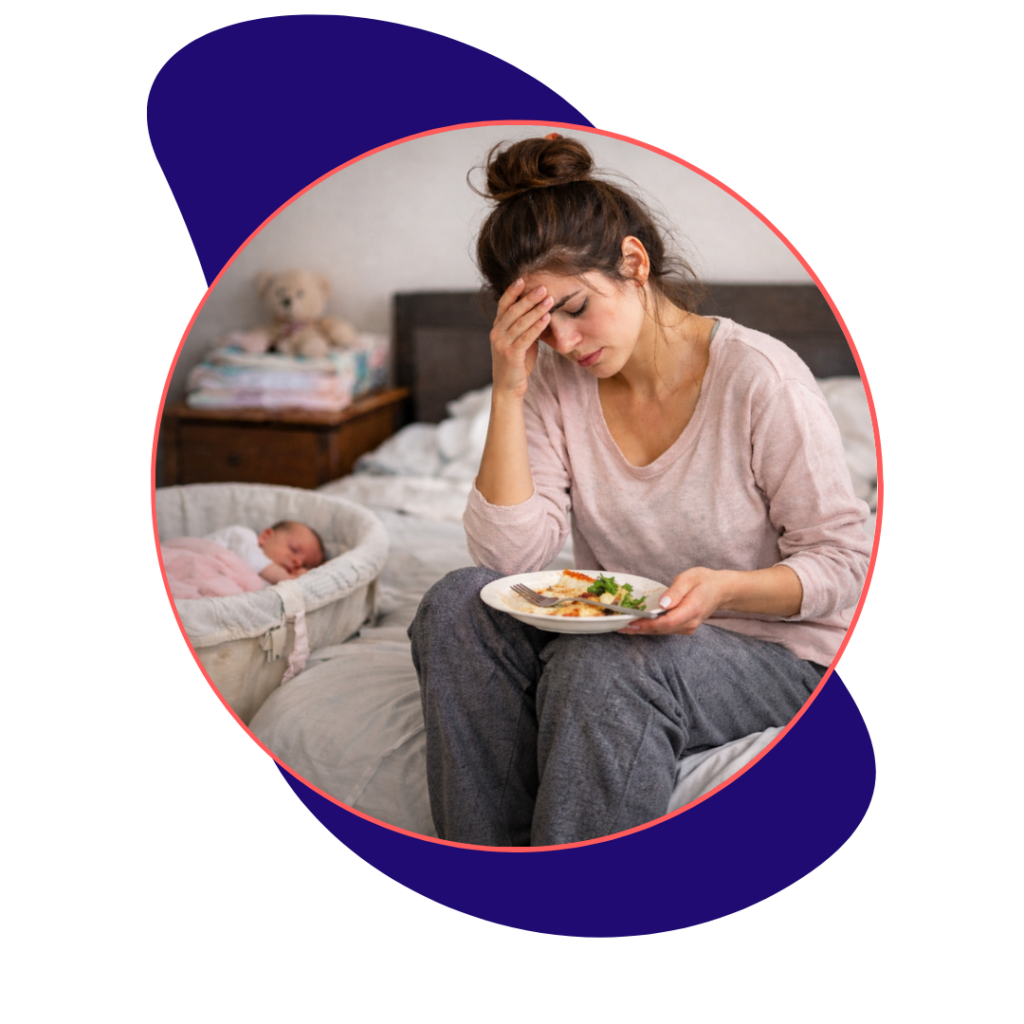
As eating disorder prevalence rises globally, maternal eating disorders have become an area of increasing concern.1,2 It is currently estimated that one in twenty pregnant women is at risk of developing an eating disorder during pregnancy.2 Fears of gaining weight and feeling fat are hallmark characteristics of eating disorders,3 and the perinatal period represents a uniquely vulnerable time for women due to rapid body changes, hormonal fluctuations, and psychosocial stressors that can exacerbate underlying risk factors.4
More than 40% of women report concerns about their weight during pregnancy, 75% worry about weight retention one month postpartum, and 70% attempt weight loss within four months postpartum.2,5 Roughly 15% of pregnant individuals have had an eating disorder previously in their lives. About 5% of women experience an eating disorder during pregnancy,6 and about 13% experience an eating disorder during the postpartum period.7
As maternal eating disorders can contribute to adverse perinatal and neonatal outcomes, it is critical that eating disorders are identified and addressed appropriately.
Maternal Mental Health Disorders and Eating Disorders
Eating disorders are closely associated with a range of maternal mental health conditions. They rarely occur in isolation during the perinatal period. Women with current or past eating disorders are significantly more likely to experience perinatal depression and anxiety, with studies showing rates up to two to three times higher than among women without eating disorders.8 They are also at increased risk for developing post-traumatic stress symptoms, particularly associated with pregnancy and childbirth.8 These comorbidities not only compound the psychological burden on mothers but also increase the risk of relapse during and after pregnancy.
The intersection of eating disorders and maternal mental health is particularly concerning, given that both are associated with elevated mortality risk.910,With respect to maternal mental health, suicide is a leading cause of maternal mortality in the United States,9 and eating disorders have the second-highest mortality rate of any psychiatric illness.10 Despite these risks, perinatal mental health clinical practice guidelines do not address screening and treatment of EDs, and there are no professional association recommendations to screen for EDs during the perinatal period. Additionally, research examining the links among maternal mortality, eating disorders, and suicide remains scarce.11 Recognizing the connection between eating disorders and maternal mental health is crucial to ensuring that women receive comprehensive care that addresses both psychological and physical risks.
Types of Eating Disorders
The following are common eating disorders:
- Anorexia Nervosa involves severe restriction of food intake and intense concerns about weight or body image.
- Bulimia Nervosa is characterized by cycles of binge eating followed by compensatory behaviors such as self-induced vomiting, fasting, excessive exercise, or misuse of laxatives, diuretics, or other medications.
- Binge Eating Disorder involves recurrent episodes of consuming unusually large amounts of food, often rapidly and beyond the point of fullness, typically accompanied by feelings of loss of control, shame, or guilt.
- Avoidant/Restrictive Food Intake Disorder (ARFID) involves extreme restriction in the amount or type of food eaten, unrelated to body image concerns, and may stem from sensory sensitivities, low interest in eating, or fear of negative consequences such as choking or vomiting.
- Pica is characterized by the ingestion of non-food items with no nutritional value for reasons that are not developmentally or culturally appropriate.
- Other Specified Feeding or Eating Disorders (OSFED) describes clinically significant eating concerns that do not meet the full criteria for other diagnoses. Examples include atypical anorexia, subthreshold bulimia nervosa, or binge eating disorder, purging disorder, and night eating syndrome.
Eating disorders during pregnancy most often include anorexia nervosa, bulimia nervosa, binge eating disorder, and other specified feeding and eating disorders (OSFED).
All eating and body image concerns should be taken seriously, regardless of whether a diagnosable disorder is present, as disordered eating can present a range of risks and complications even when full diagnostic criteria aren’t met.12 Disordered eating encompasses a broad range of unhealthy behaviors and obsessive thoughts regarding nutrition, body image, and weight management. While these habits, such as chronic dieting, food restriction, bingeing, or the misuse of exercise and weight-loss aids, can be physically and emotionally taxing, they generally don’t reach the specific clinical thresholds required for a formal eating disorder diagnosis.13
Consequences
The consequences of maternal eating disorders are far-reaching, increasing the risk of both maternal and infant morbidity and mortality. Women with a history of eating disorders have a higher risk of relapse during the perinatal period.13 Severe disordered eating during pregnancy is associated with higher rates of postpartum anxiety, depression, and suicidality, as well as increased risk of obstetric complications such as gestational diabetes, preeclampsia, and cesarean delivery.14,15
Infants born to mothers with eating disorders face heightened risks such as low Apgar scores, abnormal birth weights, premature delivery, feeding difficulties, developmental impacts, and attachment challenges.5,14,16,17,18,19 Maternal eating disorders can also have intergenerational and secondary consequences: negative perinatal outcomes may increase the risk of eating disorders in adult offspring, and families impacted by maternal eating disorders may experience relational strain, caregiver stress, and financial burden.19
Barriers to Screening and Treatment
Despite the known risks, multiple barriers prevent individuals from receiving adequate care. Although many providers screen for anxiety and depression, eating disorders are rarely included in traditional perinatal assessments due to time constraints, limited provider training, and persistent cultural stigma that discourages open discussion of disordered eating.20 Even when risk is identified, specialized referral options are often scarce. Few providers specialize in eating disorders during the perinatal period, making referrals challenging, particularly without integrated networks that connect OB/GYNs, mental health providers, and registered dietitians who specialize in eating disorders.4
Telehealth has expanded access for some, but geographic barriers remain for many people in underserved or rural areas.20 Financial accessibility further compounds these gaps. Insurance coverage for eating disorder treatment is frequently inconsistent or inadequate, which leaves many patients unable to afford the care they need.20 Addressing these barriers requires systemic reforms that expand provider education, strengthen integrated care pathways, and ensure equitable insurance coverage for maternal eating disorder treatment.
Community Recommendations
To effectively address maternal eating disorders, interventions must extend beyond clinical care and leverage community resources. Community-based strategies can reduce stigma, increase early detection, and provide ongoing support for pregnant and postpartum individuals at risk. Key recommendations include:
- Integrate eating disorder screenings into perinatal mental health assessments. Early detection of eating disorders reduces the risk of developing complications, and screening questions can be incorporated into existing tools to minimize adding additional strain on providers.
- Develop integrated care models. Creating collaborative care environments between OB/GYNs, mental health providers, and registered dietitians ensures appropriate referrals to eating disorder-informed specialists, which can reduce relapse risk and improve health outcomes for both mothers and infants.
- Expand local resource accessibility. Enhancing local and digital directories can help providers and families easily locate telehealth services, specialists, and other community resources.
- Launch public education and awareness campaigns. Partnering with community organizations, maternal health programs, and schools can raise awareness regarding eating disorder risks during pregnancy and highlight the importance of early recognition and support.
- Build peer and family support networks. Community-based peer groups and family education initiatives promote understanding of eating disorders while providing safe, non-clinical spaces for connection and support.
- Encourage culturally responsive approaches. Collaboration with local leaders can ensure messaging and services reflect the cultural and linguistic needs of diverse communities, helping reduce stigma and improve accessibility.
By strengthening awareness, reducing stigma, and building integrated care pathways, communities can help bridge the gap between clinical services and the lived experiences of mothers.
Policy Recommendations
Federal maternal mental health programs and state-level perinatal quality collaboratives rarely address eating disorders. To reduce structural barriers to screening, treatment, and support, federal, state, and institutional policies should promote sustainable change by improving affordability, accountability, and access. Policy recommendations include:
- Mandate insurance coverage. Ensure comprehensive coverage for eating disorder treatment, including nutritional counseling, therapy, and telehealth services during the pregnancy and postpartum periods.
- Expand provider training and continuing education. Fund training initiatives to equip OB/GYNs, midwives, primary care providers, and mental health professionals with the knowledge to recognize and address eating disorders in perinatal populations.
- Increase research funding. Expand federal investment in maternal eating disorder research to advance understanding of prevalence, screening tools, and effective interventions that guide evidence-based policy and best practices.
- Enhance perinatal screening protocols. Require the incorporation of eating disorder screenings into routine prenatal and postpartum assessments alongside anxiety and depression screenings.
- Incentivize integrated care models. Encourage health systems to establish multidisciplinary perinatal care teams that connect obstetric, psychiatric, and nutrition services.
Recognizing and addressing maternal eating disorders within policy frameworks is essential to transforming perinatal mental health care and improving outcomes for mothers, infants, and future generations.
Conclusion
Maternal eating disorders remain an underrecognized but critical threat to maternal and infant health. Despite evidence of their prevalence and serious consequences, screening, treatment, and policy responses remain insufficient. Pregnancy and the postpartum period are times of heightened vulnerability, and without deliberate attention, mothers and infants face preventable medical, psychological, and intergenerational harm. Addressing these challenges will require community engagement, improved provider education, and systemic policy reform that integrates eating disorders into the broader maternal mental health landscape. With these changes, we can close care gaps, reduce stigma, and improve the health and well-being of mothers, infants, and families for generations to come.
For additional information, see the National Eating Disorders Association resource: nationaleatingdisorders.org/what-are-eating-disorders/.
Original Draft Writing and Research: Nicole Gouhin, NEDA Public Health Intern
Subject Matter Supervision and Editor: Shivani Dutt, NEDA Manager, Mission Initiatives
Copy Editor: Kelly Nielson
Policy Supervision/Review: Joy Burkhard, Executive Director, Policy Center and Jessica Scheer, NEDA Acting CEO
Final Draft Writing and Editing: Cindy Herrick
- Galmiche, M., Déchelotte, P., Lambert, G., & Tavolacci, M. P. (2019). Prevalence of eating disorders over the 2000–2018 period: A systematic literature review. The American Journal of Clinical Nutrition, 109(5), 1402–1413. https://doi.org/10.1093/ajcn/nqy342 ↩︎
- Martínez-Olcina, M., Rubio-Arias, J. A., Reche-García, C., Leyva-Vela, B., Hernández-García, M., Hernández-Morante, J. J., & Martínez-Rodríguez, A. (2020). Eating Disorders in Pregnant and Breastfeeding Women: A Systematic Review. Medicina, 56(7), 352. https://doi.org/10.3390/medicina56070352 ↩︎
- Ralph-Nearman, C., Hooper, M. A., Hunt, R. A., & Levinson, C. A. (2024). Dynamic relationships among feeling fat, fear of weight gain, and eating disorder symptoms in an eating disorder sample. Appetite, 195, 107181. https://doi.org/10.1016/j.appet.2023.107181 ↩︎
- Sebastiani, G., Andreu-Fernández, V., Herranz Barbero, A., Aldecoa-Bilbao, V., Miracle, X., Meler Barrabes, E., Balada Ibañez, A., Astals-Vizcaino, M., Ferrero-Martínez, S., Gómez-Roig, M. D., & García-Algar, O. (2020). Eating Disorders During Gestation: Implications for Mother’s Health, Fetal Outcomes, and Epigenetic Changes. Frontiers in Pediatrics, 8. https://doi.org/10.3389/fped.2020.00587 ↩︎
- Zerwas, S., & Claydon, E. (2014). Eating Disorders Across the Life-Span: From Menstruation to Menopause. In Women’s Reproductive Mental Health Across the Lifespan (pp. 237–261). Springer International Publishing. https://doi.org/10.1007/978-3-319-05116-1_13 ↩︎
- Bye, A., Martini, M. G., & Micali, N. (2021). Eating disorders, pregnancy and the postnatal period: A review of the recent literature. Current Opinion in Psychiatry, 34(6), 563–568. https://doi.org/10.1097/yco.0000000000000748 ↩︎
- Pettersson, C. B., Zandian, M., & Clinton, D. (2016). Eating disorder symptoms pre- and postpartum. Archives of Women’s Mental Health, 19(4), 675–680. https://doi.org/10.1007/s00737-016-0619-3 ↩︎
- Easter, A., Solmi, F., Bye, A., Taborelli, E., Corfield, F., Schmidt, U., Treasure, J., & Micali, N. (2014). Antenatal and Postnatal Psychopathology Among Women with Current and Past Eating Disorders: Longitudinal Patterns. European Eating Disorders Review, 23(1), 19–27. https://doi.org/10.1002/erv.2328 ↩︎
- Mangla, K., Hoffman, M. C., Trumpff, C., O’Grady, S., & Monk, C. (2019). Maternal self-harm deaths: An unrecognized and preventable outcome. American Journal of Obstetrics and Gynecology, 221(4), 295–303. https://doi.org/10.1016/j.ajog.2019.02.056 ↩︎
- Arcelus, J., Mitchell, A. J., Wales, J., & Nielsen, S. (2011). Mortality Rates in Patients With Anorexia Nervosa and Other Eating Disorders: A Meta-analysis of 36 Studies. Archives of General Psychiatry, 68(7), 724–731. https://doi.org/10.1001/archgenpsychiatry.2011.74 ↩︎
- Howard, L. M., Molyneaux, E., Dennis, C.-L., Rochat, T., Stein, A., & Milgrom, J. (2014). Non-psychotic mental disorders in the perinatal period. The Lancet, 384(9956), 1775–1788. https://doi.org/10.1016/s0140-6736(14)61276-9 ↩︎
- Sommerfeldt, B., Skårderud, F., Kvalem, I. L., Gulliksen, K. S., & Holte, A. (2022). Bodies out of control: Relapse and worsening of eating disorders in pregnancy. Frontiers in Psychology, 13. https://doi.org/10.3389/fpsyg.2022.986217 ↩︎
- Disordered Eating: Identifying, Treating, Preventing, and Differentiating It From Eating Disorders | Diabetes Spectrum | American Diabetes Association. (n.d.). Retrieved February 9, 2026, from https://diabetesjournals.org/spectrum/article-abstract/20/3/141/2114/Disordered-Eating-Identifying-Treating-Preventing?redirectedFrom=fulltext ↩︎
- Chan, C. Y., Lee, A. M., Koh, Y. W., Lam, S. K., Lee, C. P., Leung, K. Y., & Tang, C. S. K. (2019). Course, risk factors, and adverse outcomes of disordered eating in pregnancy. International Journal of Eating Disorders, 52(6), 652–658. https://doi.org/10.1002/eat.23065 ↩︎
- Janas-Kozik, M., Żmijowska, A., Zasada, I., Jelonek, I., Cichoń, L., Siwiec, A., & Wilczyński, K. M. (2021). Systematic Review of Literature on Eating Disorders During Pregnancy—Risk and Consequences for Mother and Child. Frontiers in Psychiatry, 12. https://doi.org/10.3389/fpsyt.2021.777529 ↩︎
- Mantel, Ä., Hirschberg, A. L., & Stephansson, O. (2020). Association of Maternal Eating Disorders With Pregnancy and Neonatal Outcomes. JAMA Psychiatry, 77(3), 285. https://doi.org/10.1001/jamapsychiatry.2019.3664 ↩︎
- Watson, H. J., Zerwas, S., Torgersen, L., Gustavson, K., Diemer, E. W., Knudsen, G. P., Reichborn-Kjennerud, T., & Bulik, C. M. (2017). Maternal eating disorders and perinatal outcomes: A three-generation study in the Norwegian Mother and Child Cohort Study. Journal of Abnormal Psychology, 126(5), 552–564. https://doi.org/10.1037/abn0000241 ↩︎
- Nilsson, I. A. K., Ozsvar, J., Gissler, M., & Lavebratt, C. (2024). Maternal Eating Disorders, Body Mass Index, and Offspring Psychiatric Diagnoses. JAMA Network Open, 7(10), e2440517. https://doi.org/10.1001/jamanetworkopen.2024.40517 ↩︎
- Martini, M. G., Barona-Martinez, M., & Micali, N. (2020). Eating disorders mothers and their children: A systematic review of the literature. Archives of Women’s Mental Health, 23(4), 449–467. https://doi.org/10.1007/s00737-020-01019-x ↩︎
- Penwell, T. E., Bedard, S. P., Eyre, R., & Levinson, C. A. (2024). Eating Disorder Treatment Access in the United States: Perceived Inequities Among Treatment Seekers. Psychiatric Services, 75(10), 944–952. https://doi.org/10.1176/appi.ps.20230193 ↩︎