Rural Health Transformation Maternal Mental Health Learning Collaborative
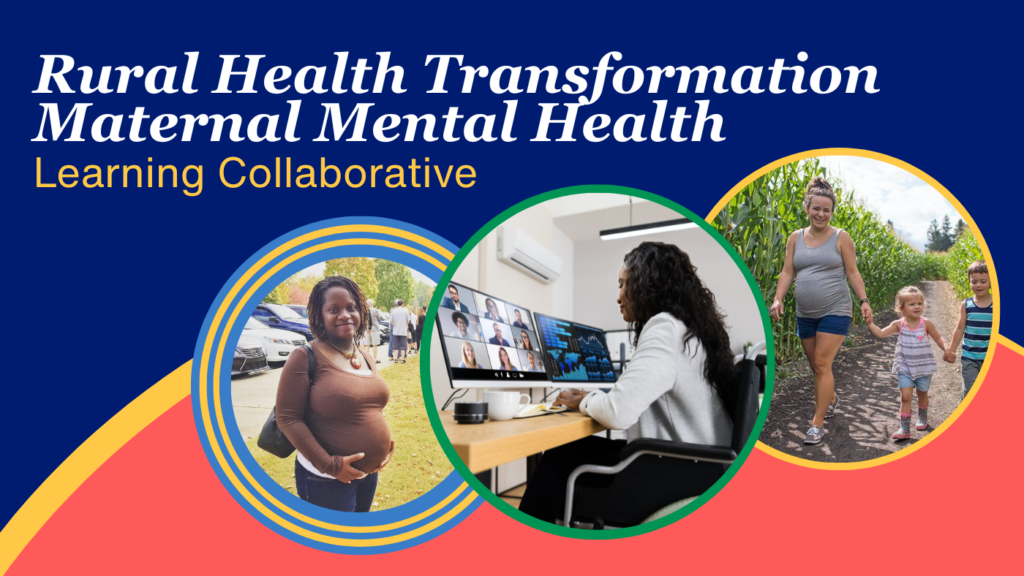
The Policy Center for Maternal Mental Health invites state agency leaders from Medicaid, Rural Health Transformation Offices, and other applicable state agency leaders to apply for a six-month learning collaborative to support implementation of Rural Health Transformation (RHT) Program Grants. As states advance strategies to improve maternal and mental health outcomes through RHT programs, this collaborative offers a structured opportunity to deepen learning, share best practices, and receive targeted technical assistance.
Building on the Policy Center’s guidance released by the National Governors Association, we will explore innovative and scalable approaches, paired with quality monitoring and payment pathways for sustainability.
Participants will engage in six monthly expert-led group sessions with RHT agency leaders in roughly 10 other states.
States will also receive a minimum of two individualized technical assistance (TA) consultations focused on translating solutions into practice through states’’ unique delivery systems and existing programs where possible.
Some of What You Will Learn
- Advance Rural Workforce Policy and Financing
Align Medicaid, public health, and higher education to expand rural obstetric and behavioral health pipelines, strengthen retention through loan repayment and incentives, and integrate lay professionals,, including community health workers and peer support specialists,, to improve access to care. - Expand Home-Based and Mobile Care Infrastructure
Examine model programs for in homes and mobile care. Define provider place of service payment pathways for Medicaid and commercial plans, to overcome transportation and stigma barriers and increase engagement in prenatal and postpartum care. - Leverage Tele-Health Consultation and Technology to Extend Specialty Care
Implement provider-to-provider telepsychiatry consultation and digital supports that connect rural providers with mental health specialists, accelerating screening, treatment, and continuity of care. - Use Medicaid Managed Care as a System-Level Lever
Embed quality improvement reporting requirements in managed care contracts using HEDIS measures to drive accountability, improving detection, follow-up, and population-level outcomes. - Build Integrated Care Models in Obstetric Deserts
Explore piloting Regional Maternity Care Centers and obstetric hubs that co-locate obstetric and behavioral health services and integrate home visiting and community supports, restoring essential maternal health infrastructure in high-need regions.
Requirements: Only registrants with a government agency position will be accepted. We require two-three leaders with program design and implementation authority to apply per state (only one application is required).
Session Dates: October 2026 through March 2027, first Tuesday of each month from 10:00am-12:00pm Pacific Time
Oct. 6
Nov. 3
Dec. 1
Jan. 5
Feb. 2
March. 2
Cost: $2,900 per state group
Registration: Complete this application form.
One letter of recommendation and acknowledgement from a director-level leader in Medicaid, the Rural Health Transformation Office, or HHS is also required. Only one letter is needed per applying state – the names and titles of the state’s 2-3 applicants must be listed in the letter.
Registration Deadline: The application for the 2026 -27 cohort is open through 12 midnight Eastern time on August 28
Acceptance Notification: Applicants will be notified of their acceptance status the week of September 4 and payment must be received by September 31st
Why the Policy Center for Maternal Mental Health
The Policy Center brings a proven track record of translating policy into practice through longstanding Nonprofit and Government Agency Fellowship programs delivered via 12-month learning collaboratives. These programs have demonstrated measurable, scalable impact across states, supporting the implementation of substantive maternal mental health quality improvement initiatives and bipartisan legislation. Through structured peer learning, targeted technical assistance, and systems-focused strategy, the Policy Center has helped states advance screening, reimbursement, care coordination, and access to treatment, positioning it uniquely to support Rural Health Transformation efforts and accelerate outcomes for women and children.
Future Cohort
If you are interested in receiving information regarding joining our next cohort, please complete this interest form.