Background
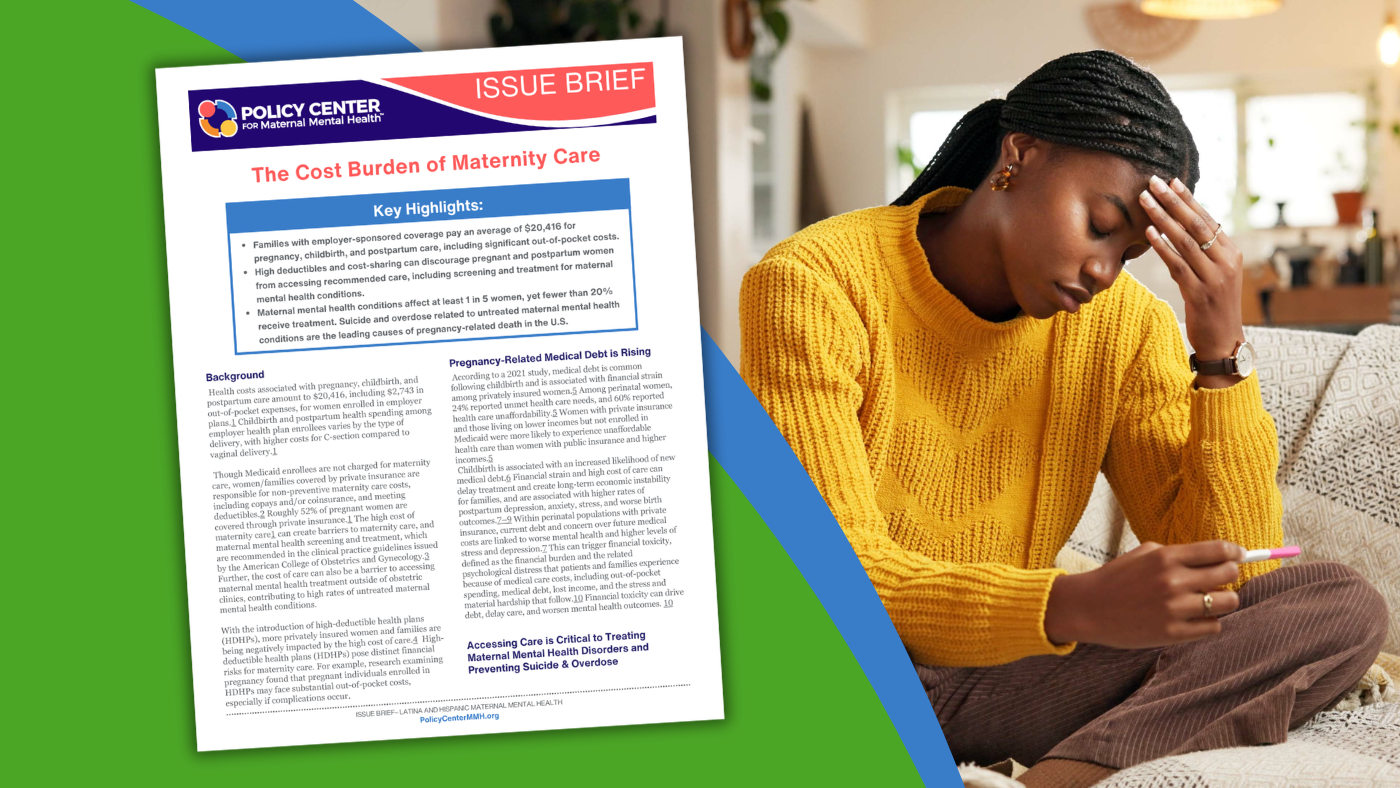
Health costs associated with pregnancy, childbirth, and postpartum care amount to $20,416, including $2,743 in out-of-pocket expenses, for women enrolled in employer plans.1 Childbirth and postpartum health spending among employer health plan enrollees varies by the type of delivery, with higher costs for C-section compared to vaginal delivery.1
Though Medicaid enrollees are not charged for maternity care, women/families covered by private insurance are responsible for non-preventive maternity care costs, including copays and/or coinsurance, and meeting deductibles.2 Roughly 52% of pregnant women are covered through private insurance.1 The high cost of maternity care1 can create barriers to maternity care, and maternal mental health screening and treatment, which are recommended in the clinical practice guidelines issued by the American College of Obstetrics and Gynecology.3 Further, the cost of care can also be a barrier to accessing maternal mental health treatment outside of obstetric clinics, contributing to high rates of untreated maternal mental health conditions.
With the introduction of high-deductible health plans (HDHPs), more privately insured women and families are being negatively impacted by the high cost of care.4 High-deductible health plans (HDHPs) pose distinct financial risks for maternity care. For example, research examining pregnancy found that pregnant individuals enrolled in HDHPs may face substantial out-of-pocket costs, especially if complications occur. Further, some individual-market HDHPs have excluded maternity coverage altogether.4 Even when maternity care is covered, when a patient has a diagnosis, prenatal visits may not be coded as preventive, and therefore, visits can be subject to the deductible. This can be a disincentive to accessing care. Because pregnancy, labor and delivery, and postpartum care frequently span two plan years, families may also face two separate annual deductibles. As a result, out-of-pocket maternity costs under HDHPs can be substantial.4
Pregnancy-Related Medical Debt is Rising
According to a 2021 study, medical debt is common following childbirth and is associated with financial strain among privately insured women.5 Among perinatal women, 24% reported unmet health care needs, and 60% reported health care unaffordability.5 Women with private insurance and those living on lower incomes but not enrolled in Medicaid were more likely to experience unaffordable health care than women with public insurance and higher incomes.5
Childbirth is associated with an increased likelihood of new medical debt.6 Financial strain and high cost of care can delay treatment and create long-term economic instability for families, and are associated with higher rates of postpartum depression, anxiety, stress, and worse birth outcomes.7,8,9 Within perinatal populations with private insurance, current debt and concern over future medical costs are linked to worse mental health and higher levels of stress and depression.7 This can trigger financial toxicity, defined as the financial burden and the related psychological distress that patients and families experience because of medical care costs, including out-of-pocket spending, medical debt, lost income, and the stress and material hardship that follow.10 Financial toxicity can drive debt, delay care, and worsen mental health outcomes. 10
Financial Toxicity: The financial burden and the related psychological distress that patients and families experience because of medical care costs, including out-of-pocket spending, medical debt, lost income, and the stress and material hardship that follow.
Accessing Care is Critical to Treating Maternal Mental Health Disorders and Preventing Suicide & Overdose
Maternal mental health conditions, such as depression, anxiety, and substance use disorders, are the most common complications of pregnancy and childbirth, affecting at least 20% of women during the perinatal period.11 Research indicates that fewer than 20% of these women will be treated, regardless of the cost of care.11 Furthermore, these conditions are the leading cause of pregnancy-related maternal mortality in the United States, due to women dying of suicide or overdose in the first year postpartum. These tragedies are largely preventable, but only if screening and timely interventions are available and accessible to those who need them most.12
Unbundling Maternity Care Payment May Shift Costs to Patients
Effective 1/1/2026, obstetric providers (OB/gyns and midwives) will no longer be reimbursed through a global maternity bundled payment for prenatal, delivery, and postpartum care,13 When obstetric providers bill insurers for care, they also collect copays and coinsurance when the appointment includes treatment for any form of diagnosis other than pregnancy (and therefore not covered under the provision of the U.S. Preventive Services Task Force cost share waivers for preventive care). Privately insured patients, particularly those with high deductible plans, will now face cost-sharing during pregnancy, not just for labor and delivery and postpartum care.
Policy Implications
Congress should pass legislation waiving cost-sharing for all maternity and maternal health care, including prenatal care, postpartum care, labor and delivery, and any inpatient and neonatal intensive care unit stays for newborns. Congress should also pass legislation to waive the cost of mental health care during the perinatal period.
Conclusion and Call to Action
Eliminating maternity care cost-sharing was already urgent; now there is even greater urgency. Removing the cost of having a baby in the U.S. is a critical step to addressing financial barriers to support timely access to maternal health and maternal mental health care and to eliminating the financial hardship many families face after having a baby.
References
- Winger, A., Rae, M., & Cox, C. (2025). Health Costs Associated with Pregnancy, Childbirth, and Infant Care. KFF. https://www.kff.org/health-costs/health-costs-associated-with-pregnancy-childbirth-and-postpartum-care/ ↩︎
- KFF. (2025, June 27). Pregnancy-Related Preventive Services for Adults Covered by the ACA. https://www.kff.org/affordable-care-act/pregnancy-related-preventive-services-covered-by-the-aca/ ↩︎
- Nonacs, R. (2024, July 3). What Are the Barriers to Accessing Perinatal Mental Health Services? [MGH Center for Women’s Mental Health]. https://womensmentalhealth.org/posts/barriers-to-access-perinatal-mental-health-services/ ↩︎
- KFF. (2007). Maternity Care and Consumer-Driven Health Plans. https://www.kff.org/wp-content/uploads/2013/01/7636.pdf ↩︎
- Taylor, K., Sarah Compton, Giselle E. Kolenic, John Scott, Nora Becker, Vanessa K. Dalton, & Michelle H. Moniz. (2021). Financial Hardship Among Pregnant and Postpartum Women in the United States, 2013 to 2018. JAMA Network Open, 4(10). https://jamanetwork.com/journals/jamanetworkopen/fullarticle/2785593 ↩︎
- Moniz, M. H., Stout, M. J., Kolenic, G. E., Carlton, E. F., Scott, J. W., Miller, M. M., & Becker, N. V. (2024). Association of Childbirth With Medical Debt. Obstetrics and Gynecology, 143(1), 11–13. https://doi.org/10.1097/AOG.0000000000005381 ↩︎
- Gompers, A., Larson, E., Esselen, K. M., Farid, H., & Dodge, L. E. (2023). Financial toxicity in pregnancy and postpartum. Birth, 50(3), 606–615. https://doi.org/10.1111/birt.12710 ↩︎
- Marcil, L. E., Campbell, J. I., Silva, K. E., Hughes, D., Salim, S., Nguyen, H.-A. T., Kissler, K., Hole, M. K., Michelson, C. D., & Kistin, C. J. (2020). Women’s Experiences of the Effect of Financial Strain on Parenting and Mental Health. Journal of Obstetric, Gynecologic, and Neonatal Nursing : JOGNN, 49(6), 581–592. https://doi.org/10.1016/j.jogn.2020.07.002 ↩︎
- Friedline, T., Chen, Z., & Morrow, S. (2021). Families’ Financial Stress & Well-Being: The Importance of the Economy and Economic Environments. Journal of Family and Economic Issues, 42(Suppl 1), 34–51. https://doi.org/10.1007/s10834-020-09694-9 ↩︎
- Zafar, S. Y., & Abernethy, A. P. (2013). Financial Toxicity, Part I: A New Name for a Growing Problem. Oncology (Williston Park, N.Y.), 27(2), 80–149. ↩︎
- Byatt, N., Levin, L. L., Ziedonis, D., Moore Simas, T. A., & Allison, J. (2015). Enhancing Participation in Depression Care in Outpatient Perinatal Care Settings: A Systematic Review. Obstetrics & Gynecology, 126(5), 1048. https://doi.org/10.1097/AOG.0000000000001067 ↩︎
- Trost, S., Beauregard, J., Chandra, G., Njie, F., Goodman, D., Berry, J., & Harvey, A. (2022, September 26). Pregnancy-Related Deaths: Data from Maternal Mortality Review Committees in 36 US States, 2017–2019 | CDC. https://www.cdc.gov/reproductivehealth/maternal-mortality/erase-mm/data-mmrc.html ↩︎
- Policy Center for Maternal Mental Health. (2024, May 3). Maternal Mental Health Care—Obstetric Provider Services Billing and Reimbursement Guide. https://policycentermmh.org/maternal-mental-health-care-obstetric-provider-services-billing-and-reimbursement-guide/ ↩︎