The H.R. 1 legislation signed into law by President Trump in July 2025, among other things, requires “able-bodied” adults enrolled in Medicaid to report 80 hours per month of “community engagement,” which includes work, volunteering, or school, to be eligible for Medicaid coverage effective January 1, 2027. The law requires states to verify enrollees’ eligibility every six months, beginning with renewals scheduled on or after January 1, 2027.
Exemptions
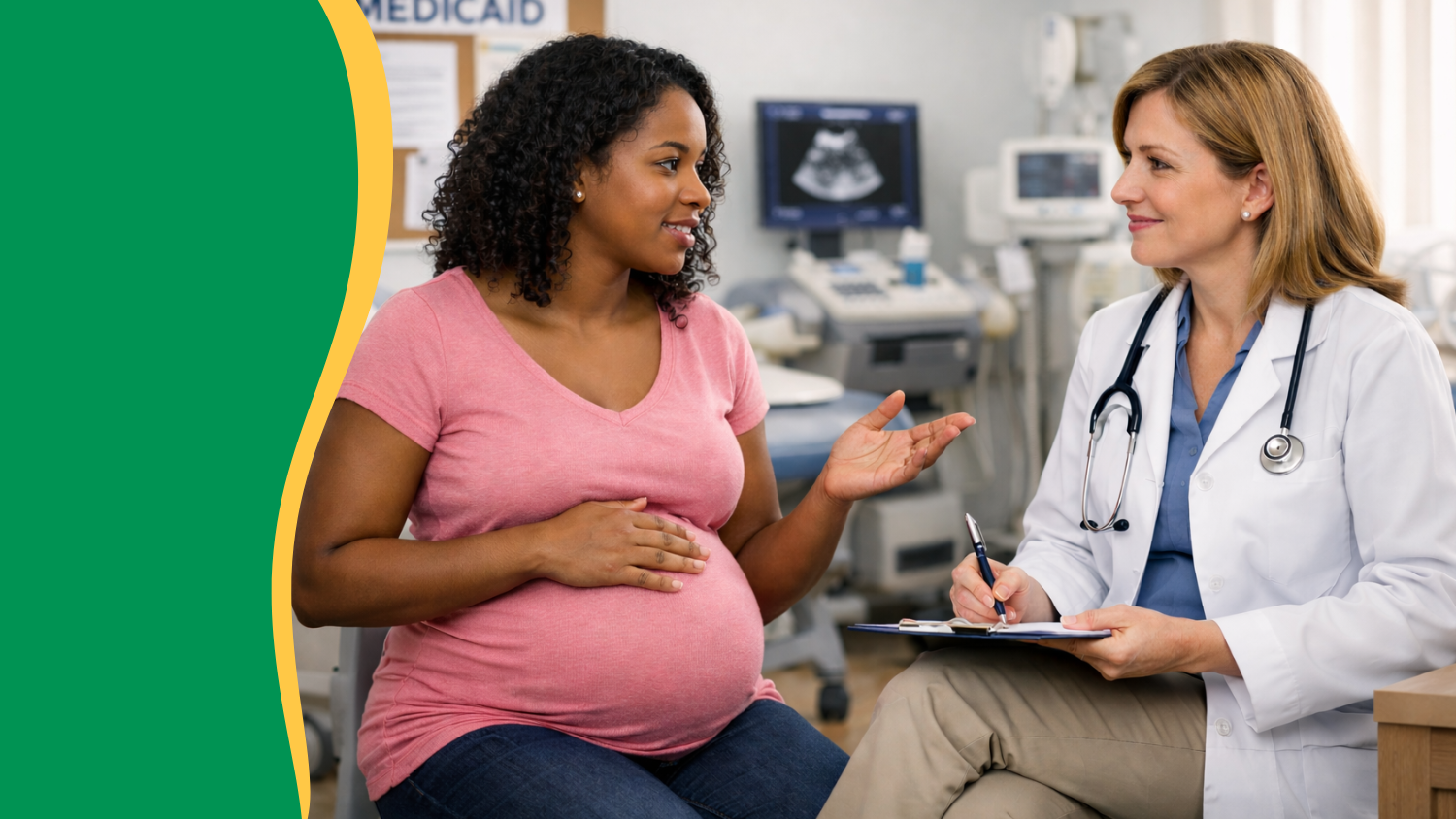
There are several groups exempted from work requirements, including those who are pregnant or in the postpartum period, defined as “pregnant or entitled to postpartum medical assistance,” which includes the traditional 60-day postpartum coverage period and the 12-month Medicaid extension.
Though this overview focuses on the perinatal period, our readers should be aware that the law also provides an exemption to “parent, guardian, caretaker, relative, or family caregiver of a dependent child 13 years of age and under or a disabled individual.” Additionally, those with a “disabling mental disorder” or substance use disorder (SUD) are also exempt from Medicaid work requirements under the “medically frail” designation which we detail further below.
CMS Guidance and Regulations
The Centers for Medicare & Medicaid Services (CMS) first issued guidance to states on the law on December 8, 2025, and again on March 6, 2026. CMS released an Interim Final Rule (IFR) on June 1, 2026 (with a comment period) that outlines a national framework for implementation of the work reporting requirements; it does not change the exception for those who are pregnant and postpartum.
The December 2025 guidance reiterated that states must implement enrollee/beneficiary work-reporting requirements for adults aged 19–64 who are not eligible for an exemption by January 1, 2027, and that states must inform current enrollees of these requirements in advance, beginning in June 2026. States must also verify that work or exemption criteria have been met at the time of application and at renewal.
Automated Work / Community Engagement Verification is Required
The law mandates that states prioritize automated verification systems to “establish whether an individual met the community engagement requirement or was not required to do so.” States can and should also rely heavily on administrative data matching (“ex parte” verification) for exemptions, rather than asking beneficiaries to submit documentation.
Our recommendations:
Use Claims Data and a Pregnancy Notification Form
Claims Data
To develop an ex-parte system for pregnancy and postpartum exemptions, states should rely on claims data. The timing of the sunsetting of maternity bundle payment aligns well. No longer will a single claim be submitted after a postpartum visit has been provided. Medicaid Agencies can require their health plans to incentivize OB providers to bill the visit confirming pregnancy as soon as possible (ideally within 30 days), with higher payments for earlier billing.
In 2023, the Centers for Medicare & Medicaid Services (CMS) released “Maternal and Infant Health (MIH): Identifying Pregnant and Postpartum Beneficiaries in Medicaid and CHIP Administrative Data – Technical Specifications.” Though the MIH technical specifications were not specifically for H.R.1 work requirement implementation, they can be useful to state Medicaid agencies in operationalizing a pregnancy/postpartum exemption process.
The MIH specifications direct states to use Medicaid claims data as follows:
- Use diagnosis codes & procedure codes to find pregnancy-related claims.
- Flag each claim for pregnancy, delivery, miscarriage, etc.
- Aggregate to the beneficiary level (combine all claims for each person)
- Assign categories (such as pregnant, postpartum after live birth, etc.)
Federal law (Balanced Budget Act of 1997 and Affordable Care Act) requires states to collect claims data (referred to as encounter data). States can, and do, require frequent (e.g., monthly) submission of encounter data by managed care organizations (health plans). If a state has not moved to managed care, the state processes claims directly and will therefore have direct access to claims. States can and do use health plan (managed care organization) or provider (fee-for-service) contract amendments to enforce rapid data sharing.
States Should Develop and Test These Systems Now
State Medicaid agencies (SMAs) can identify pregnant enrollees via Medicaid claims data by searching for a pregnancy diagnosis code and then again at 9 months via labor and delivery claims data, providing 12 additional months of postpartum coverage from that date. Using claims to determine exemption status can prevent perinatal enrollees from being erroneously subjected to work-reporting requirements and the associated risk of losing coverage.
To allow ample time to adapt and test this logic, and combine it with eligibility systems data, State Medicaid Agencies should assign information technology (IT) staff to work with the state’s maternal health director to implement and test a pregnant/postpartum exemption framework.
Self-Attestation Processes
Because of claim-filing lag time, it is still necessary to implement notification processes for OBs and patients/enrollees. Medicaid agencies should develop an exemption reporting process that includes patient attestations and can require health plans/OB providers to post notices for patients.
Notice of Pregnancy Form
Obstetric providers can be asked to submit pregnancy notices. For example, Iowa Medicaid has developed a Notice of Pregnancy (NOP) form that providers submit to the Medicaid agency after the initial pregnancy confirmation office visit.
Women/birthing people should also be able to self-attest to being pregnant, given some may be delayed in obtaining prenatal care for reasons such as lack of transportation, child care, or inability to locate an OB provider, for example.
To ease the operational transition, the June 2026 IFR explicitly notes that CMS will allow enrollees to self-attest to these exemptions during the first year of implementation (calendar year 2027). However, this is a temporary flexibility. From 2028 onward, if state electronic administrative data cannot verify an exemption, an enrollee can self-attest that they are exempt only once. Following that single self-attestation, if the state’s automated systems still cannot locate a matching medical claim or electronic record, the state must request manual documentation from the individual. Enrollees will be given a strict 30-day window to provide this paperwork; if they cannot prove their exemption or compliance within 30 days, states are required to disenroll them from Medicaid.
Substance Use and Mental Health Disorder Exemptions
In addition to pregnancy and postpartum, as well as parenting exemptions, those with a “disabling mental disorder” or substance use disorder (SUD) are also exempt from Medicaid work requirements under the “medically frail” designation. Under the June 1, 2026 IFR, states have significant discretion to decide which medical conditions qualify as disabling mental health disorders. Under the IFR to claim the addiction exemption, an individual must actively participate in a recognized drug or alcohol treatment program, which states will verify using a strict one-month look-back period at application and renewal.
Mental Health America and Inseparable released a guide for state Medicaid agencies to perform ex-parte verifications of people with substance use disorders and disabling mental disorders. The guide contains six different categories of data for states to examine in order to perform the verifications:
· Diagnosis codes
· Place of service codes
· Revenue codes
· CPT codes
· HCPCS codes
· Medications
Closing Recommendations
Concerns Raised
Though CMS states the goal is to “connect members to work,” concern has been raised that the administrative hurdles required for enrollees to report their work hours and/or exceptions could jeopardize their qualified coverage.
Our recommendations
Use Trusted Messengers to Remind People They Qualify
Many families may simply not apply for or fail to renew Medicaid coverage in 2027 because they are unaware of work requirement exemptions.
Trusted messengers, including Ob/Gyns and doulas, for example, can help communicate that pregnancy and the postpartum period are exempt from work requirements. State Medicaid Agencies can use contract amendments to require these providers to communicate these exemptions to their patients/clients.
We will continue to monitor the impact on access to perinatal coverage and care.
On March 26, 2026, this article was updated to add the self-attestation process. On April 27, this article was updated to include an obstetric provider pregnancy notification form and a new guide developed by Mental Health America and Inseparable to address severe mental illness exemptions.
On May 7, 2026, this article was updated to suggest that a pregnancy notification form be adopted by state Medicaid agencies for reporting by the OB provider.
On June 3, 2026, this article was updated to include information from the CMS Interim Final Rule published on June 1, 2026 and change the title from “Medicaid Work Requirements and Access to Perinatal Care” to “Considerations for Medicaid Agencies in Implementing Pregnant and Postpartum Work Requirement Exemptions.”