2026 State Report Cards Methodology & Measures
What changed in 2026?
There are four main changes to the MMH State Report Card measures in 2026:
1. New Measure: Perinatal psychiatry consultation programs
In 2026, states gain 1 point for having a perinatal psychiatry consultation program. To note: Three states received a half-point for their perinatal psychiatry consultant program. California’s program is only for Los Angeles county; Maryland’s program focuses on SUD-only, and Tennessee’s program is in-process.
2. Updated Measure: State meets ratio of MMH psychiatric provider prescribers
This year, states gain 2 points for having 3 MMH-certified psychiatric provider prescribers per 50,000 birthing persons in the state. Previously, states gained 3 points for having 1 MMH-certificated psychiatric provider prescribers per 50,000 birthing persons. The new ratio reflects updated calculations that account for a more realistic caseload of patients that MMH-certified psychiatric provider prescribers may see in a given year.
3. New Domain: Parental Support
In 2026, The Policy Center for MMH added a new “Parental Support” domain to the report cards, which includes six measures related to paid leave and childcare.
State performance on these measures will not impact the overall state grade. Instead, performance on these measures will create a stand-alone “Parental Support” score on state policy related to paid leave and childcare.States’ “Parental Support” score is intended to be looked at in-tandem with their overall state grade.
These six new measures include:
- Public paid parental leave is available. Points: 1 point if the state has a mandated public paid parental leave program and is at least 8 weeks. Source: National Conference of State Legislators, Paid Leave Tracker, 2025
- Public paid parental leave is at least 12 weeks. Points: 0.5 point if the state provides 12 weeks of public paid parental leave. Source: National Conference of State Legislators, Paid Leave Tracker, 2025
- Pay during leave is 100% of wages for the lowest income families. Points: 1 point if the lowest income individuals (<100% FPL) receive at least 100% of their average weekly wages during leave; 0.5 point if the lowest income individuals receive 80%-99% of pay during leave. Source: BiPartisan Policy Center, Wage Replacement Rates, 2024
- Childcare availability. Points:1 point if the “gap” between the number of childcare slots and the children who may need childcare is <10%; 0.5 point if the gap is between 10-20%. (The national average is 28%.) Source: BiPartisan Policy Center’s, National & State Child Care Data Overview, 2025
- Childcare affordability. Points: 1 point if childcare is free for all, 0.5 point if childcare costs are 30% or less of the average single-income household earnings. (The national average is 35%). Source: BiPartisan Policy Center’s, National & State Child Care Data Overview, 2025 (Note: This measure looks at the average cost among single-income households to capture the population that is the most in need. Additionally, childcare costs are not broken down by age, since this data is not available for all US states.)
- Eligibility for childcare subsidies is >=85% state median income. Points: 0.5 point if the state sets the childcare subsidy income eligibility limit at >=85% SMI (state median income). Source: Prenatal to 3 Policy Center, 2025 State Policy Roadmap (Note: In many cases, states may have childcare subsidy waitlists or enrollment freezes that may prevent subsidies from being used.)
4. Updated Domains
In 2026, the Policy Center updated the measures included in each “domain” in the MMH State Report Cards. The 2026 report cards include 27 measures across four domains:
Domain 1: Screening/Detection
- Medicaid requires MCOs to report “prenatal depression screening” HEDIS measure
- Medicaid requires MCOs to report “postpartum depression screening” HEDIS measure
- Top performer on the “prenatal depression screening” HEDIS measure (among commercial insurance and/or Medicaid
- Top performer on the “postpartum depression screening” HEDIS measure (among commercial insurance and/or Medicaid)
Domain 2: Providers and Treatment
- Meets ratio of MMH therapists and other non-prescribers (5 per 1,000 births)
- Meets ratio of MMH psychiatric provider prescribers (3 per 5,000 births)
- Has a perinatal psychiatry consultation program for OBs Has at least one inpatient or residential MMH treatment program
- Has at least one MMH intensive outpatient program (IOP) or partial hospitalization program (PHP)
- Meets ratio of community-based organizations (CBOs) providing direct service for MMH (at least 1 per 50,000 births)
Domain 3: Policy and Payment
- State Perinatal Quality Collaborative (PQC) has prioritized MMH
- Has or has had a state-sanctioned MMH Task Force or Commission
- Requires Medicaid/commercial health plans to develop an MMH quality management program
- Expanded Medicaid (is an ACA Medicaid expansion state)
- Extended Medicaid coverage to one year postpartum
- Provides enhanced Medicaid reimbursement or state investment in group prenatal care
- Medicaid provides reimbursement for group parenting programs (without requiring the child have a diagnosis)
- Maternity provider prenatal MMH screening claim submission rate meetings threshold (private insurance)
- Maternity provider postpartum MMH screening claim submission rate meets threshold (private insurance)
- Provider prenatal MMH treatment claim submission rate is at least 10% (private insurance)
- Provider postpartum MMH treatment claim submission rate is at least 10% (private insurance)
Domain 4: Parental Support (New!)
- Public paid parental leave is available
- Public paid parental leave is at least 12 weeks
- Pay during leave is 100% for the lowest-income families
- Childcare availability
- Childcare affordability
- Eligibility for childcare subsidies is >85% state median income
2026 Measures by Domain
Domain 1: Screening/Detection
1. Medicaid requires MCOs to report “prenatal depression screening” HEDIS measure
- Item: State Medicaid agency requires reporting of HEDIS PND-E measure
- Dataset: 2026 update to the Policy Center for MMH’s analysis of State Medicaid HEDIS requirements, found in The Role of Medicaid in Advancing Obstetric Provider Maternal Mental Health Screening and Treatment
- Scoring: 2 points if measure is reported, 3 points if Medicaid provides MCOs an incentive payment for performance on this measure
2. Medicaid requires MCOs to report “postpartum depression screening” HEDIS measure
- Item: State Medicaid agency requires reporting of HEDIS PDS-E measure
- Dataset: 2026 update to the Policy Center for MMH’s analysis of State Medicaid HEDIS requirements, found in The Role of Medicaid in Advancing Obstetric Provider Maternal Mental Health Screening and Treatment
- Scoring: 2 points if measure is reported, 3 points if Medicaid provides MCOs an incentive payment for performance on this measure
3. Top performer on the HEDIS “prenatal depression screening” measure (among commercial insurance and/or Medicaid)
- Item: State HEDIS prenatal depression screening measure scores are >=10%
- Dataset: HEDIS State Reporting dataset for RY 2025/MY 2024
- Scoring: 4 points if HEDIS measure scores are >=10%
4. Top performer on the HEDIS “postpartum depression screening” measure (among commercial insurance and/or Medicaid)
- Item: State HEDIS postpartum depression screening measure scores are >=10%
- Dataset: HEDIS State Reporting dataset for RY 2025/MY 2024
- Scoring: 4 points if HEDIS measure scores are >=10%
Domain 2: Providers and Treatment
5. Meets ratio of MMH therapists and other non-prescribers (5 per 1,000 births)
- Item: The state has at least 5 MMH-certified therapists or other non-prescribers for every 1,000 births. (Providers include Perinatal Mental Health Certified (PMH-C) providers and university health system maternal mental health program providers.)
- Datasets: PSI PMH-C Directory and Marce of North America’s list of Reproductive Mental Health Academic Programs
- Scoring: 3 points for states that meet the ratio
6. Meets ratio of MMH psychiatric provider prescribers (3 per 5,000 births)
- Item: The state has at least three psychiatric provider prescribers with specialized perinatal training for every 5,000 births. (Specialized perinatal training includes MDs and other psychiatric providers who have received training as reproductive psychiatrists. This measure excludes OB/Gyns, though it is recommended that OB/Gyns and other maternity care providers prescribe medications according to clinical guidelines.)
- Dataset: PSI Prescriber Directory, the Marce of North America’s list of Reproductive Mental Health Academic Program
- Scoring: 2 points for states that meet the ratio
7. Has a perinatal psychiatry consultation program (New!)
- Item: State has a perinatal psychiatry consultation program for obstetric providers
- Dataset: The Policy Center for MMH’s Perinatal Psychiatry Consultation Program List
- Scoring: 1 point for states that have a MMH psychiatry consultation program.
- Note: Three states received a half-point for their perinatal psychiatry consultant program. California’s program is only for Los Angeles county; Maryland’s program focuses on SUD-only, and Tennessee’s program is in-process.
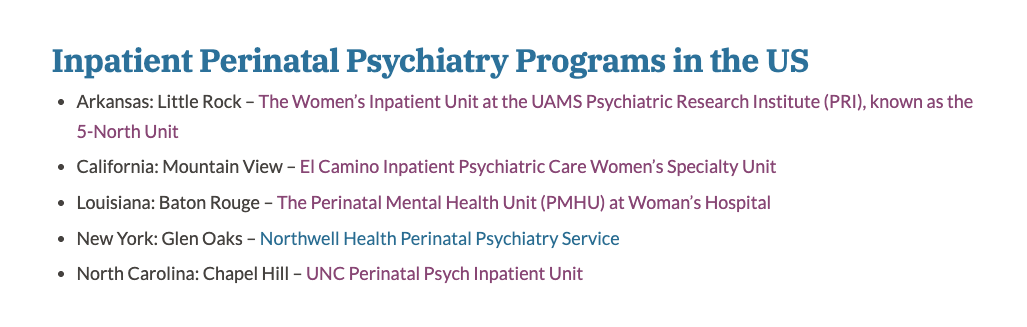
8. Has at least one inpatient or residential MMH treatment program
- Item: The state has MMH inpatient program(s) or residential program(s). This excludes residential treatment programs providing only Substance Use Disorder treatment, such as “Pregnant and Postpartum Women” programs.
- Dataset: Postpartum Support International list of inpatient programs
- Scoring: 1 point per program, capped at 3 points per state
9. Has at least one MMH intensive outpatient program (IOP) or partial hospitalization program (PHP)
- Item: The state has an outpatient MMH program(s)
- Dataset: Postpartum Support International list of outpatient programs
- Scoring: 1 point per program, capped at 3 points per state
10. Meets ratio of community-based organizations (CBOs) providing direct service for MMH (at least 1 per 50,000 births)
- Item: State has at least 1 CBO providing MMH services per 50,000 births
- Dataset: Policy Center for Maternal Mental Health’s Nonprofit list
- Scoring: If state meets ratio of 1 CBO per 50,000 births, state receives 1 point per CBO, capped at 3 points per state.
- Note: This measure remains preliminary, with low reliability. Additional CBOs can be submitted to the Policy Center for Maternal Mental Health’s Nonprofit map.
Domain 3: Policy and Payment
11. State Perinatal Quality Collaborative (PQC) has prioritized MMH
- Item: State PQC has named MMH as a priority
- Dataset: The National Network of Perinatal Quality Collaborative’s list of PQCs prioritizing MMH
- Scoring: If state PQC has made MMH a priority, state receives 1 point
12. Has or had a state-sanctioned MMH Task Force or Commission
- Item: State has or had formed a MMH Task Force or Commission to issue a strategic plan
- Dataset: 2026 MMH Task Force Tracker
- Scoring: 3 points if state has or had a Task Force or Commission
13. Requires Medicaid/commercial health plans to develop an MMH quality management program
- Item: The state mandates that commercial and Medicaid health plans/insurers develop a MMH quality management program
- Dataset: Mandated MMH Quality Management Program Tracker
- Scoring: 3 points if the state mandates health plans/insurers have a MMH quality management program
14. Expanded Medicaid (is an ACA Medicaid expansion state)
- Item: The state has adopted Medicaid expansion
- Dataset: Kaiser Family Foundation Medicaid Expansion Tracker
- Scoring: 1 point if the state had expanded Medicaid
15. Extended Medicaid coverage to one year postpartum
- Item: State implemented or is planning to implement postpartum coverage for Medicaid beneficiaries to 12 months postpartum
- Dataset: Kaiser Family Foundation Postpartum Medicaid Extension Tracker
- Scoring: 2 points if the state has extended Medicaid coverage to one year postpartum
16. Provides enhanced Medicaid reimbursement or state investment in group prenatal care
- Item: State provides enhanced Medicaid reimbursement or invests funding in group prenatal care
- Dataset: 2025 Prenatal To 3 Policy State Policy Roadmap
- Scoring: State receives 1 point if the state provides enhanced reimbursement; 1 point if state reimburses through the Medicaid program or funds group prenatal care in another manner; 2 points if state provides both.
- Note: This measure only provides points if a state provides an “enhanced rate” for group prenatal care. Typically, providers need the extra boost from the enhanced rate to justify the investment (costs for trainings, resources, additional staff, and additional appointment time) in a group model.
17. Medicaid provides reimbursement for group parenting programs (without requiring child diagnosis)
- Item: State Medicaid provides reimbursement for parenting programs (without requiring the child have a diagnosis)
- Dataset: 2023 Infant-Early Childhood Mental Health (IECMH) Medicaid Survey
- Scoring: 2 points for each state that meets this measure
18. Maternity providers’ prenatal MMH screening claim submission rate meets threshold (private insurance)
- Item: % persons who are privately insured and pregnant whose provider billed for mental health screening. (Note: Providers include nurse practitioners, physician assistants, OB/Gyns, family practice providers, and midwives.)
- Dataset: Analysis of FAIR Health NPIC® (National Private Insurance Claims) Database; 2024 claims data. Procedure codes included in the dataset can be found here.
- Scoring: Points provided based on the percentage of patients whose provider bills private insurance for prenatal MMH screening: 1-3% = 0.5 points, 3%-14% = 1 point, 15% or higher = 3 points. States with reported OB screening > 1% receive 1 extra point.
- Disclaimer: FAIR Health, Inc. is not responsible for the research or opinions expressed in this publication.
19. Maternity providers’ postpartum MMH screening claim submission rate meets threshold (private insurance)
- Item: % persons who are privately insured and in the postpartum period whose provider billed for mental health screening. (Note: Providers include nurse practitioners, physician assistants, OB/Gyns, family practice providers, and midwives.)
- Dataset: Analysis of FAIR Health NPIC® (National Private Insurance Claims) Database; 2024 claims data. Procedure codes included in the dataset can be found here.
- Scoring: Points provided based on the percentage of patients whose provider bills private insurance for postpartum MMH screening: 1-3% = 0.5 points, 3%-14% = 1 point, 15% or higher = 3 points.
- Disclaimer: FAIR Health, Inc. is not responsible for the research or opinions expressed in this publication.
20. Providers’ prenatal MMH treatment claim submission rate is at least 10% (private insurance)
- Item: % persons who are privately insured and pregnant whose provider billed for mental health treatment.
- Dataset: Analysis of FAIR Health NPIC® (National Private Insurance Claims) Database; 2024 claims data. Procedure codes included in the dataset can be found here.
- Scoring: Points provided based on the percentage of patients whose provider bills private insurance for prenatal mental health treatment: 10%-14% = 1 point, 15% or higher = 3 points
- Note: For this measure, providers include psychiatrists, psychiatric nurses, psychologists, behavioral health providers, registered nurses, nurse practitioners, physician assistants, OB/Gyns, midwives, and family practice. (Note: “MMH treatment” among non-behavioral health providers is provided through evaluation & management.)
- Disclaimer: FAIR Health, Inc. is not responsible for the research or opinions expressed in this publication.
21. Providers’ postpartum MMH treatment claim submission rate is at least 10% (private insurance)
- Item: % persons who are privately insured in the postpartum period whose provider billed for mental health treatment (any provider)
- Dataset: Analysis of FAIR Health NPIC® (National Private Insurance Claims) Database; 2024 claims data. Procedure codes included in the dataset can be found here.
- Scoring: Points provided based on the percentage of patients whose provider bills private insurance for postpartum mental health treatment: 10%-14% = 1 point, 15% or higher = 3 points)
- Note: For this measure, providers include psychiatrists, psychiatric nurses, psychologists, behavioral health providers, registered nurses, nurse practitioners, physician assistants, OB/Gyns, midwives, and family practice. (Note: “MMH treatment” among non-behavioral health providers is provided through evaluation & management.)
- Disclaimer: FAIR Health, Inc. is not responsible for the research or opinions expressed in this publication.
Domain 4: Parental Support (New!)
22. Public paid parental leave is available (New!)
- Item: State has a mandated public paid parental leave program and it is at least 8 weeks.
- Dataset: National Conference of State Legislators, Paid Leave Tracker, 2025
- Points: 1 point if the state has a mandated public paid parental leave program and is at least 8 weeks.
23. Public paid parental leave is at least 12 weeks (New!)
- Item: State has a mandated public paid parental leave program that is at least 12 weeks.
- Dataset: National Conference of State Legislators, Paid Leave Tracker, 2025
- Scoring: 0.5 point if the state provides 12 weeks of public paid parental leave.
24. Pay during leave is 100% of wages for the lowest income families (New!)
- Item: State has a mandated public paid parental leave program that provides 100% of wages for the lowest income families (<100% FPL). States receive half points if the state provides 80-99% of wages to the lowest income families (<100% FPL).
- Dataset: BiPartisan Policy Center, Wage Replacement Rates, 2024
- Scoring: 1 point if the lowest income individuals (<100% FPL) receive at least 100% of their average weekly wages during leave; 0.5 point if the lowest income individuals receive 80%-99% of pay during leave.
25. Childcare availability (New!)
- Item: The “gap” between the number of childcare slots and the children who may need childcare is <10%. States receive half points if the “gap” is 10-20%.
- Dataset: BiPartisan Policy Center’s, National & State Child Care Data Overview, 2025
- Scoring: 1 point if the “gap” between the number of childcare slots and the children who may need childcare is <10%; 0.5 point if the gap is between 10-20%.
26. Childcare affordability (New!)
- Item: State provides free childcare for all. States receive half points if childcare costs are 30% of less of the average single-income household earnings.
- Dataset: BiPartisan Policy Center’s, National & State Child Care Data Overview, 2025
- Scoring: 1 point if childcare is free for all, 0.5 point if childcare costs are 30% or less of the average single-income household earnings. (The national average is 35%.)
- Note: This measure looks at the average cost among single-income households to capture the population that is the most in need. Additionally, childcare costs are not broken down by age, since this data is not available for all US states.
27. Eligibility for childcare subsidies is >=85% state median income (New!)
- Item: The state sets the childcare subsidy income eligibility limit at >=85% SMI (state median income).
- Dataset: Prenatal to 3 Policy Center, 2025 State Policy Roadmap
- Scoring: 0.5 point if the state sets the childcare subsidy income eligibility limit at >=85% SMI (state median income).
- Note: In many cases, states may have childcare subsidy waitlists or enrollment freezes that may prevent subsidies from being used.)
For more information regarding data or methodology, please email [email protected].