Our work shaping and reporting on national mental health policy is made possible through a capacity grant from the Perigee Fund.
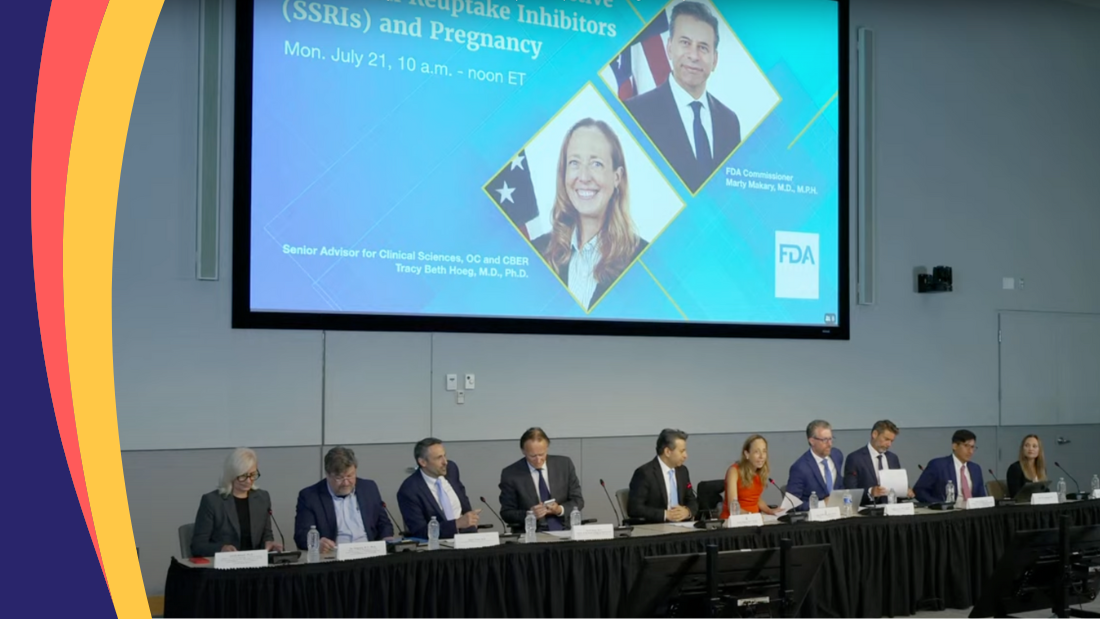
On July 21, 2025, the FDA convened an Expert Roundtable on Selective Serotonin Reuptake Inhibitors (SSRIs) and Pregnancy. Organizations such as The American College of Obstetricians and Gynecologists (ACOG) and the National Curriculum in Reproductive Psychiatry (NCRP) have raised concerns about many of the panelists disregarding the research about the safety of SSRIs as well as the adverse outcomes of not treating depression during pregnancy effectively.
Approximately 6% of pregnant individuals who experience depression are prescribed an SSRI.1 While the use of SSRIs during pregnancy is not without risks, SSRIs are among the most studied medications used in pregnancy.2 The use of SSRIs for individuals with moderate to severe perinatal depression and anxiety is recommended by clinical professional organizations such as the American Psychiatric Association (APA), The American College of Obstetrics and Gynecologists (ACOG), and the Society for Maternal-Fetal Medicine (SMFM), among others.
A majority of the panelists focused on the potential negative outcomes of SSRI use on infants, and only one of the panelists, Dr. Kay Roussos-Ross, a board-certified physician in Obstetrics and Gynecology, Psychiatry, and Addiction Medicine, gave adequate attention to the well-documented risks of untreated illness, which include preterm birth, poor prenatal care, impaired bonding, and maternal suicide, a leading cause of maternal mortality. As Dr. Roussos-Ross emphasized, rigorous research confirms that the risks of untreated psychiatric illness often outweigh the risks of medication use when SSRIs are appropriately prescribed.
While some experts on the panel presented the treatment of maternal depression as a binary choice between SSRIs and non-pharmacological interventions, it is crucial that SSRIs and non-pharmacological strategies are not viewed as mutually exclusive treatments.3,4,5,6 Rather, SSRIs are one part of comprehensive and holistic care. When prescribed, SSRIs are often used in conjunction with psychotherapy, lifestyle strategies, and social support.
As FDA Commissioner Dr. Marty Makary noted during the panel, treating maternal depression requires holistic healthcare systems that must identify and treat upstream drivers of mental health struggles and not just their symptoms. This approach aligns directly with the National Strategy to Improve Maternal Mental Health Care, released by the Task Force in May 2024, which proposes care that is comprehensively integrated across medical, community, and social systems.
Policy Recommendations
Currently, many pregnant women face challenges in receiving comprehensive treatment for maternal mental health disorders due to various systemic and policy barriers. To adequately address these barriers, policymakers must act to:
- Ensure continued access to evidence-based treatments, including SSRIs
- Address maternity care reimbursement to promote integrated behavioral health care in obstetric settings
- Expand access to paid family leave, a foundational policy for promoting recovery, bonding, and mental health stability
- Fund research that closes evidence gaps by ethically including pregnant women in clinical trials
- Prioritize coverage of care navigation so women are aware of the range of evidence-based interventions and supports that are available, and have the ability to access them with ease
In closing, expert associations have raised concerns about the experts who served on this FDA expert panel ignoring the evidence base surrounding SSRIs in pregnancy. Gaps in research must be prioritized, all evidence-based treatments must be available to women, and their doctors must be empowered to assist them in making decisions that right for them based on risks and benefits.
References
- Andrade, S. E., Reichman, M. E., Mott, K., Pitts, M., Kieswetter, C., Dinatale, M., Stone, M. B., Popovic, J., Haffenreffer, K., & Toh, S. (2016). Use of selective serotonin reuptake inhibitors (SSRIs) in women delivering liveborn infants and other women of child-bearing age within the U.S. Food and Drug Administration’s Mini-Sentinel program. Archives of Women’s Mental Health, 19(6), 969–977. https://doi.org/10.1007/s00737-016-0637-1 ↩︎
- Lebin, L. G., & Novick, A. M. (2022). Selective serotonin reuptake inhibitors (SSRIs) in pregnancy: An updated review on risks to mother, fetus, and child. Current Psychiatry Reports, 24(11), 687–695. https://doi.org/10.1007/s11920-022-01372-x ↩︎
- Richmond, L. M. (2019). APA releases new statement on perinatal disorders. Psychiatric News, 54(6). https://doi.org/10.1176/appi.pn.2019.3b19 ↩︎
- American Psychiatric Association (2018). Position Statement on Screening and Treatment of Mood and Anxiety Disorders During Pregnancy and Postpartum. http://www.psychnews.org/pdfs/Position%20Statement%20Screening_and_Treatment_of_Mood_and_Anxiety_Disorders_During_Pregnancy_and_Postpartum_2019.pdf ↩︎
- American College of Obstetricians and Gynecologists (2023). Clinical Practice Guideline: Treatment and Management of Mental Health Conditions During Pregnancy and Postpartum. https://www.acog.org/clinical/clinical-guidance/clinical-practice-guideline/articles/2023/06/treatment-and-management-of-mental-health-conditions-during-pregnancy-and-postpartum ↩︎
- National Curriculum in Reproductive Psychiatry (2025, July 21). NCRP Responds to FDA Panel on SSRI Use in Pregnancy. https://ncrptraining.org/press-release-ncrp-responds-to-fda-panel-on-ssri-use-in-pregnancy/ ↩︎