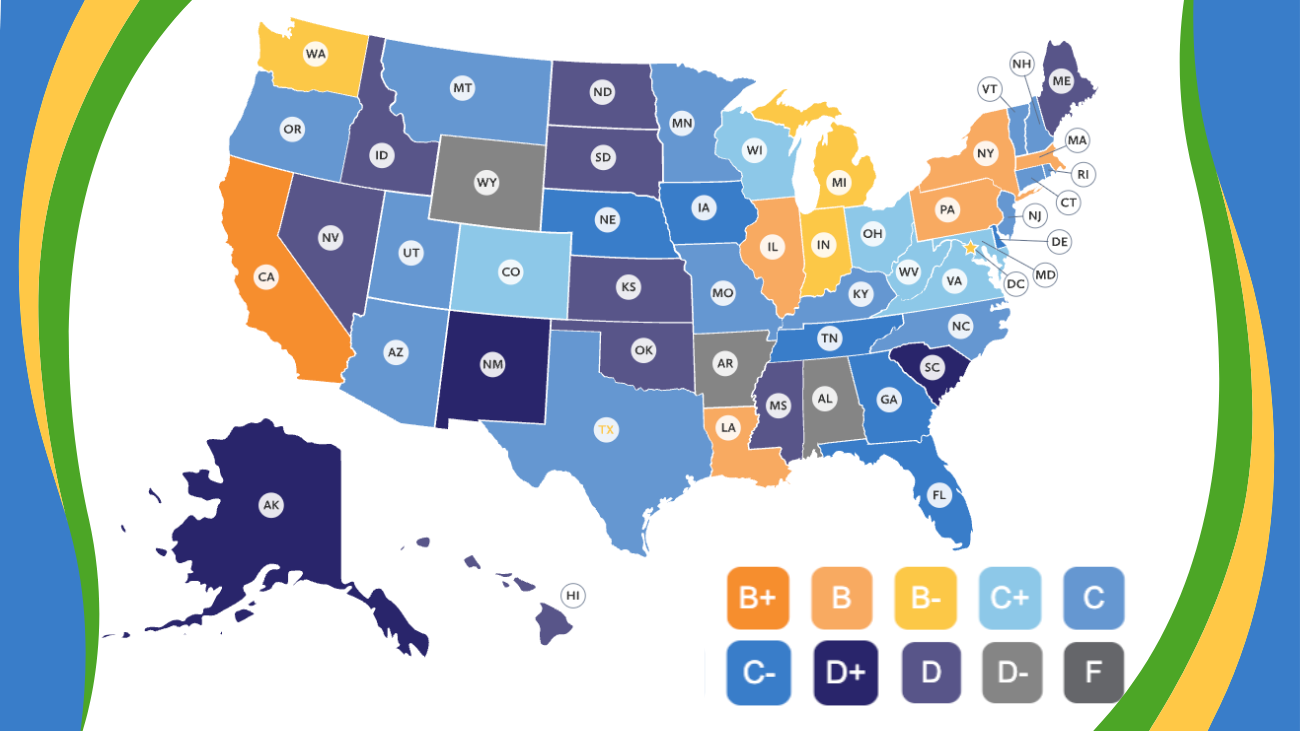
- In 2026, as in prior years, no states received As. The two states that received Fs in 2025 improved their grades to Ds.
- The overall U.S. grade improved slightly from a C- to C.
- The U.S. earned an F in the new “Parental Support” domain, which addresses paid leave and affordable, accessible childcare.
Introduction
The Policy Center for Maternal Mental Health (“Policy Center”) introduced the maternal mental health (MMH) report cards in 2023 to identify key data sets and track results by state. The 2026 report cards highlight progress, areas of opportunity, and measures that continue to serve as a roadmap for states to improve maternal mental health.
In 2026, as in years past, state grades improved incrementally, raising the national grade from a C- to a C. 11 states earned Bs (up from 5 in 2025), and 15 states earned Ds (down from 17 in 2025). No states received As or failing grades.
This year, the Policy Center added a new “Parental Support” domain to the report cards, including six measures related to paid leave and childcare. States were scored on a “five star” scale on this domain, and their performance underscored how far states have to go on paid leave and childcare. 31 states earned fewer than 1 star, and only 14 earned 2 or more stars in the new domain. Overall, the US earned the equivalent to an “F” on this new domain.
Measures
The 2026 Maternal Mental Health (MMH) state report cards include 27 measures across 4 domains:
- Domain 1: Screening/Detection
- Domain 2: Providers and Treatment
- Domain 3: Policy and Payment
- Domain 4: Parental Support (New!)
In 2026, several updates were made to the report card measures:
- New “Parental Support” domain: A new domain was added with six measures related to paid leave and childcare.
- New measure added to “Providers and Treatment” domain: A new measure was added to provide points to states that have a perinatal psychiatry consultation program for OB providers.
- Updated measure in the “Providers and Treatment” domain: The ratio was updated in the “state meets ratio of MMH psychiatric provider prescribers” measure. This update accounts for a more realistic caseload of patients that a MMH-certified psychiatric provider may see in a given year.
- Updated domains: The domain names and measures included in each domain were refreshed in 2026. The four domains are now titled: 1) Screening/Detection, 2) Providers and Treatment, 3) Policy and Payment, and 4) Parental Support (new).
To see the full list of measures, including new measures and methods changes see the 2026 MMH State Report Cards Methodology and Measures.
Results
Overall state grades
In 2026, 11 states earned the highest grade of B, and while the others earned Cs and Ds.
| State Grades | 2026 |
|---|---|
| B grades | 11 states (CA, DC, IL, IN, LA, MA, MI, NY, PA, WA, WV) |
| C grades | 25 states (AZ, CO, CT, DE, FL, GA, IA, KY, MD, MN, MO, MT, NC, NE, NH, NJ, OH, OR, RI, TN, TX, UT, VA, VT, WI) |
| D grades | 15 states (AK, AL, AR, HI, ID, KS, ME, MS, ND, NM, NV, OK, SC, SD, WY) |
Year over year, states have improved, with states moving up in all grade categories:
| State Grades | 2023 | 2024 | 2025 | 2026 |
|---|---|---|---|---|
| B grades | 1 state (CA) | 3 states (CA, PA, WA) | 5 states (CA, CO, MI, PA, WA) | 11 states (CA, DC, IL, IN, LA, MA, MI, NY, PA, WA, WV) |
| C grades | 10 states | 19 states | 27 states | 25 states |
| D grades | 25 states | 24 states | 17 states | 15 states |
| F grade | 15 states | 5 states (AL, AR, NV, SD, MS) | 2 states (AL, MS) | 0 states |
New “Parental Support” domain scores
In 2026, the Policy Center added a “Parental Support” domain to the report cards. The new domain includes six measures of family leave and childcare policies, which can be found below. States were scored on this new domain using a “five-star” scale, which is intended to be looked at in-tandem with their overall state grade.
States could earn up to five stars in total. 31 states received less than 1 star, and only 14 states earned two or more stars. Among these 14 states, 12 states earned 2 stars, 1 state earned 3 stars (VA), and Maine state earned the highest ranking at 3.5 stars. Overall, the US score is the equivalent of an “F” on this new domain, highlighting how far the US has to go to address paid leave and childcare.
| 2026 Parental Support Domain Scores (0-5 stars) | |
| ⭐⭐⭐⭐⭐ 5 stars | 0 states |
| ⭐⭐⭐⭐ 4-4.5 stars | 0 states |
| ⭐⭐⭐ 3-3.5 stars | 2 states (ME, VA) |
| ⭐⭐ 2-2.5 stars | 12 states (CO, CT, DC, DE, MA, MD, MN, NJ, NY, OR, TX, WA) |
| ⭐ 1-1.5 stars | 6 states (AR, AZ, CA, RI, MS, SC) |
0.5 star | 18 states (AK, AL, FL, GA, IA, ID, KS, KY, LA, NE, NH, NM, OH, OK, SD, UT, VT, WV) |
0 stars | 13 states (HI, IL, IN, MI, MO, MT, NC, ND, NV, PA, TN, WI, WY) |
The six “Parental Support” domain measures
Public paid parental leave is available and is at least 8 weeks (1 point)
- Item: State has a mandated public paid parental leave program and it is at least 8 weeks.
- Dataset: National Conference of State Legislators, Paid Leave Tracker, 2025
- Points: 1 point if the state has a mandated public paid parental leave program and is at least 8 weeks.
Public paid parental leave is at least 12 weeks (.5 points)
- Item: State has a mandated public paid parental leave program that is at least 12 weeks.
- Dataset: National Conference of State Legislators, Paid Leave Tracker, 2025
- Scoring: 0.5 point if the state provides 12 weeks of public paid parental leave.
Pay during leave is 100% of wages for the lowest income families (.5-1 point)
- Item: State has a mandated public paid parental leave program that provides 100% of wages for the lowest income families (<100% FPL). States receive half points if the state provides 80-99% of wages to the lowest income families (<100% FPL).
- Dataset: BiPartisan Policy Center, Wage Replacement Rates, 2024
- Scoring: 1 point if the lowest income individuals (<100% FPL) receive at least 100% of their average weekly wages during leave; 0.5 point if the lowest income individuals receive 80%-99% of pay during leave.
Childcare availability (.5-1 point)
- Item: The “gap” between the number of childcare slots and the children who may need childcare is <10%. States receive half points if the “gap” is 10-20%.
- Dataset: BiPartisan Policy Center’s, National & State Child Care Data Overview, 2025
- Scoring: 1 point if the “gap” between the number of childcare slots and the children who may need childcare is <10%; 0.5 point if the gap is between 10-20%.
Childcare affordability (.5-1 point)
- Item: State provides free childcare for all. States receive half points if childcare costs are 30% of less of the average single-income household earnings.
- Dataset: BiPartisan Policy Center’s, National & State Child Care Data Overview, 2025
- Scoring: 1 star if childcare is free for all, 0.5 star if childcare costs are 30% or less of the average single-income household earnings. (The national average is 35%.)
- Note: This measure looks at the average cost among single-income households to capture the population that is the most in need. Additionally, childcare costs are not broken down by age, since this data is not available for all states.
Eligibility for childcare subsidies is >=85% state median income (.5 points)
- Item: The state sets the childcare subsidy income eligibility limit at >=85% SMI (state median income).
- Dataset: Prenatal to 3 Policy Center, 2025 State Policy Roadmap
- Scoring: 0.5 point if the state sets the childcare subsidy income eligibility limit at >=85% SMI (state median income).
- Note: In many cases, states may have childcare subsidy waitlists or enrollment freezes that may prevent subsidies from being used.
Which states met each measure?
The states that met each of the 27 measures in the 2026 report cards can be found below. To see the full list of measures and their point values – including new measures and methods changes – please see the 2026 MMH State Report Cards Methodology and Measures.
| 2026 MMH State Report Card Measure | Number of States Meeting the Measure |
|---|---|
Domain 1: Screening/Detection | |
1. Medicaid requires health plans to report “prenatal depression screening” HEDIS measure | 16 states require Medicaid health plans to collect the prenatal HEDIS measure: CA, IN, IL, MI, NC, NE, NH, NJ, NM, NV, NY, PA, TX, WI, WA, WV3 states receive an extra point for providing payment incentives for these measures: IL, IN, PA Did anything change in 2026? Yes, 7 additional states met this measure (IL, NE, NH, NJ, NY, TX, WV). |
2. Medicaid requires health plans to report “postpartum depression screening” HEDIS measure | 19 states require Medicaid health plans to collect postpartum HEDIS measure: CA, DE, IL, IN, MI, MO, MS, NE, NH, NJ, NM, NV, NY, PA, TX, VA, WA, WI, WV3 states receive an extra point for providing payment incentives for these measures: IL, MS, PA Did anything change in 2026? Yes, 11 additional states met this measure (DE, IL, IN, MO, MS, NE, NJ, NY, TX, VA, WV). |
3. Top performer on the HEDIS “prenatal depression screening” measure (among commercial insurance and/or Medicaid) | 21 states and DC have a MMH prenatal screening rate >10%: CA, CO, CT, DC, GA, IA, IL, IN, KY, LA, MA, MD, MI, MN, NM, NY, OH, PA, VA, WA, WI, WV Did anything change in 2026? Yes, 12 additional states met this measure (CT, DC, GA, IL, KY, MA, MD, MN, NY, OH, VA, WV). |
4. Top performer on the HEDIS “postpartum depression screening” measure (among commercial insurance and/or Medicaid) | 9 states and DC have a MMH postpartum screening rate >10%: CA, DC, IL, IN, LA, MI, PA, VA, WA, WI Did anything change in 2026? Yes, 5 additional states met this measure (DC, IL, IN, LA, VA). 11 states no longer met this measure (AK, AR, CO, GA, IA, MN, ND, NM, SD, TN, WY). |
Domain 2: Providers and Treatment | |
5. Meets ratio of MMH therapists and other non-prescribers (5 per 1,000 births) | 3 states and DC meet the ratio: DC, MT, NH, VT Did anything change in 2026? Yes, 1 additional state met this measure (NH). |
6. Meets ratio of MMH psychiatric provider prescribers (3 per 5,000 births). Note: In 2026, the ratio was updated to account for a more realistic caseload of patients that a MMH-certified psychiatric provider may see in a given year. | 27 states and DC meet the ratio: AK, AZ, CO, CT, DC, DE, HI, IA, ID, IL, IN, KS, MA, MD, MN, MO, MT, NC, NE, NH, NJ, NY, OR, RI, VT, WA, WV, WY Did anything change in 2026? Yes, 12 states no longer meet this measure (CA, KY, LA, ME, MI, NM, NV, OH, PA, TN, UT, VA, WI). |
7. Has a perinatal psychiatry consultation program (New!) | 30 states have a perinatal psychiatry consultation program: AR, AZ, CA, CO, CT, FL, GA, IL, IN, KS, KY, LA, MA, MD, MI, MO, MS, MT, NC, NY, PA, RI, SC, TN, TX, VA, VT, WA, WI, WV. Note: Three states received a half-point for their perinatal psychiatry consultant program (CA, MD, TN.) CA’s program is only for Los Angeles county; MD’s program focuses on SUD-only, and TN’s program is in-process. Did anything change in 2026? This measure is new as of 2026. |
8. Has at least one inpatient or residential MMH treatment program | 5 states have MMH inpatient or residential programs: AR, CA, LA, NC, NY Did anything change in 2026? No, the number of states meeting this measure has remained the same. |
9. Has at least one MMH intensive outpatient program (IOP) or partial hospitalization program (PHP) | 23 states and DC have MMH outpatient or partial hospitalization programs: CA, CO, CT, DC, FL, GA, IL, MA, MI, MN, MO, NC, ND, NJ, NY, OH, PA, RI, SC, TN, TX, UT, VA, WA Did anything change in 2026? Yes, 6 additional states met this measure (CT, GA, MA, ND, SC, TN). TX already met this measure, but gained 2 additional outpatient clinics. OH already met this measure, but gained 1 additional outpatient clinic. NV, NY, and FL each lost 1 outpatient clinic. |
10. Meets ratio of community-based organizations (CBOs) providing direct service for MMH (at least 1 per 50,000 births) | 36 states and DC meet the MMH Community-Based Organization (CBO) ratio: AL, AZ, CA, CO, DC, DE, FL, GA, HI, IL, IN, LA, MA, MD, MI, MN, MO, MS, MT, NC, NH, NJ, NM, NY, OH, OK, OR, PA, SC, SD, TN, TX, UT, VA, VT, WA, WI Did anything change in 2026? 1 additional CBO was added in LA and 1 additional CBO was added in MN. |
| Domain 3: Policy and Payment | |
11. State Perinatal Quality Collaborative (PQC) has prioritized MMH | 24 states’ PQCs make MMH a priority: CO, IA, IL, KS, KY, LA, MA, ME, MI, MN, MO, ND, NE, NH, NJ, OH, OK, SD, TN, UT, VA, VT, WA, WV Did anything change in 2026? Yes, 9 additional states met this measure (IA, IL, MN, ND, NJ, OH, SD, TN, WV). |
12. Has or had a state-sanctioned MMH Task Force or Commission | 15 states and DC have an MMH Task Force:AZ, CA, CT, DC, FL, KY, LA, MA, MD, NY, OH, OR, TN, TX, WV Did anything change in 2026? Yes, 2 additional state met this measure (CT and WV). |
13. Requires Medicaid/commercial health plans to develop an MMH quality management program | 2 states require health plans to develop a MMH QI program: CA, LA Did anything change in 2026? No additional states met this measure since the 2024 report card release. |
14. Expanded Medicaid (is an ACA Medicaid expansion state) | 40 states and DC expanded Medicaid. The 10 states that have not expanded coverage include: AL, FL, GA, KS, MS, SC, TN, TX, WI, and WY. Did anything change in 2026? No additional states met this measure since 2025. |
15. Extended Medicaid coverage to one year postpartum | 49 states and DC extended Medicaid coverage to 1 year postpartum. The one state that has not extended coverage is AR. Did anything change in 2026? Yes, 1 additional state met this measure (WI). |
16. Provides enhanced Medicaid reimbursement or state investment in group prenatal care | 13 states provide enhanced Medicaid reimbursement or state investment in group prenatal care: AZ, GA, LA, MD, MI, MO, MT, NC, NJ, OH, SC, TX, UT Did anything change in 2026? Yes, 3 additional states met this measure (AZ, MO, NC ). 4 states no longer met this measure (CA, IL, IN, NM). |
17. Medicaid provides reimbursement for group parenting programs (without requiring child diagnosis) | 6 states provide Medicaid reimbursement for group parenting programs without requiring a child diagnosis: AZ, KY, LA, MA, NY, RI Did anything change in 2026? No; updated data was unavailable for 2026. |
18. Maternity providers’ prenatal MMH screening claim submission rate meets threshold (private insurance) | 32 states had providers submit prenatal MMH screening claims to private insurers among at least 1% of patients: AK, AL, AR, AZ, CO, CT, DE, HI, IA, ID, IL, IN, MA, MD, MI, MN, MT, NC, NE, NH, NJ, NY, OH, OR, PA, RI, SC, TN, TX, UT, WA, WV Did anything change in 2026? Yes, 25 additional states met this measure. 1 state no longer meets this measure (VT). |
19. Maternity providers’ postpartum MMH screening claim submission rate meets threshold (private insurance) | 40 states had providers submit postpartum MMH screening claims to private insurers among at least 1% of patients: AK, AL, AR, AZ, CA, CO, CT, DE, FL, GA, HI, IA, ID, IL, IN, KS, KY, MA, MD, MI, MN, MO, MS, MT, NC, ND, NJ, NV, NY, OH, OR, RI, SC, TN, TX, UT, VA, WA, WV, WY7 states received an extra point for OBs specifically billing >1%: CA, CO, GA, IL, NC, NY, TN Did anything change in 2026? Yes, 27 additional states met this measure. |
20. Providers’ prenatal MMH treatment claim submission rate is at least 10% (private insurance) | 25 states had providers submit prenatal treatment claims to private insurers for at least 10% of patients: AL, AR, AZ, CA, IA, ID, IN, KS, KY, LA, MI, MT, NC, NE, NJ, NV, NY, OK, SC, SD, TN, UT, VA, WA, WY19 states and DC had providers submit prenatal treatment claims to private insurers among 15%+ of patients: AK, CO, CT, DC, DE, IL, MA, MD, ME, MN, MO, ND, NH, OH, OR, PA, RI, VT, WI, WV (earning 3 points vs. 1 point). Did anything change in 2026? Yes, 3 additional states met this measure (AL, CA, NV). 1 state no longer met this measure (HI). |
21. Providers’ postpartum MMH treatment claim submission rate is at least 10% (private insurance) | 35 states and DC had providers submit postpartum treatment claims to private insurers for at least 10% of patients: AK, AR, AZ, CA, CO, CT, DC, DE, IA, IL, IN, KS, KY, LA, MD, ME, MI, MN, MO, MT, NC, ND, NE, NH, NJ, NY, OH, OR, PA, SC, SD, UT, VA, WA, WI, WY4 states had providers submit postpartum treatment claims to private insurers among 15%+ of patients: MA, RI, VT, WV Did anything change in 2026? Yes, 6 additional states met this measure (AZ, LA, NY, SD, UT, WY). 1 state no longer met this measure (HI). |
| Domain 4: Parental Support (New!) | |
22. Public paid parental leave is available (New!) | 14 states and DC have public paid parental leave that is at least 8 weeks: CA, CO, CT, DC, DE, MA, MD, ME, MN, NJ, NY, OR, RI, VA, WA Did anything change in 2026? This measure is new as of 2026. |
23. Public paid parental leave is at least 12 weeks (New!) | 12 states and DC have public paid parental leave that is at least 12 weeks: CO, CT, DC, DE, MA, MD, ME, MN, NJ, NY, OR, VA, WA Did anything change in 2026? This measure is new as of 2026. |
24. Pay during leave is 100% of wages for the lowest income families (New!) | 1 state provides 100% pay during leave for the lowest income individuals (<100% FPL): OR 10 states and DC provide 80-99% pay during leave for the lowest income individuals (<100% FPL): CO, CT, DC, DE, MA, MD, ME, MN, NH, VA, WA Did anything change in 2026? This measure is new as of 2026. |
25. Childcare availability (New!) | 3 states have < 10% “gap” between the number of childcare slots and the children who may need childcare: AR, ME, TX11 states and DC have 10-20% “gap” between the number of childcare slots and the children who may need childcare: AZ, DC, DE, FL, IA, MD, MS, NE, NJ, OH, SC, VA Did anything change in 2026? This measure is new as of 2026. |
26. Childcare affordability (New!) | 1 state provides free childcare for all: NM9 states’ average childcare costs are 30% or less of the median single-income household earnings: AK, AL, AZ, GA, ID, MS, SC, SD, TX Did anything change in 2026? This measure is new as of 2026. |
27. Eligibility for childcare subsidies is >=85% state median income (New!) | 15 states set the childcare subsidy income eligibility limit at >=85% SMI: AR, CA, KS, KY, LA, ME, NM, NY, OK, SC, TX, UT, VA, VT, WV Did anything change in 2026? This measure is new as of 2026. |
How have state grades changed over time? (2023-2026)
In 2026, 26 states increased their grades, and 9 states’ grades fell.
| U. S. State | 2023 Grade | 2024 Grade | 2025 Grade | 2026 Grade | 2026 Parent Support Score | What Changed in 2026? |
|---|---|---|---|---|---|---|
| AK | D- | D | C- | D+ | 0.5 star | + Providers’ prenatal MMH screening claim submission rate meets threshold (private insurance) + Providers’ prenatal MMH treatment claim submission rate is 15%+ (private insurance) – Postpartum MMH screening fell below 10% via HEDIS · Grade dropped: Lost points offset gained points |
| AL | F | F | F | D- | 0.5 star | + Providers’ prenatal and postpartum MMH screening claim submission rate meets threshold (private insurance) + Providers’ prenatal MMH treatment claim submission rate is at least 10% (private insurance) |
| AR | F | F | D | D- | 1.5 stars | + Has a perinatal psychiatry consultation program + Providers’ prenatal and postpartum MMH screening claim submission rate meets threshold (private insurance) – Postpartum MMH screening fell below 10% via HEDIS · Grade dropped: Lost points offset gained points |
| AZ | C | C | C | C | 1 star | + Has a perinatal psychiatry consultation program + Provides enhanced Medicaid reimbursement or state investment in group prenatal care + Providers’ postpartum MMH screening claim submission rate meets threshold (private insurance) + Providers’ postpartum MMH treatment claim submission rate is at least 10% (private insurance) · Grade unchanged: gains not enough to raise a letter grade |
| CA | B- | B+ | B+ | B+ | 1.5 stars | + Has a perinatal psychiatry consultation program + Providers’ postpartum MMH screening claim submission rate meets threshold for OBs (private insurance) + Providers’ prenatal MMH treatment claim submission rate is at least 10% (private insurance) – Lost points for no longer meeting MMH prescriber ratio – Lost points for no longer providing enhanced Medicaid reimbursement or state investment in group prenatal care · Grade unchanged: gained points offset lost points |
| CO | C | C | B- | C+ | 2 stars | + Has a perinatal psychiatry consultation program + Providers’ prenatal MMH screening claim submission rate meets threshold (private insurance) + Providers’ prenatal MMH treatment claim submission rate is 15%+ (private insurance) – Postpartum MMH screening fell below 10% via HEDIS · Grade dropped: Lost points offset gained points |
| CT | F | D- | D | C | 2 stars | + Has a perinatal psychiatry consultation program + Gained an intensive outpatient program + Gained a MMH Task Force + Prenatal MMH screening is now >10% via HEDIS + Providers’ prenatal MMH screening claim submission rate meets threshold (private insurance) + Providers’ prenatal MMH treatment claim submission rate is 15%+ (private insurance) |
| DC | D+ | C | C | B- | 2.5 stars | + Prenatal MMH screening is now >10% via HEDIS + Postpartum MMH screening is now >10% via HEDIS |
| DE | D- | D+ | D+ | C- | 2.5 stars | + Requires Medicaid health plans to report the postpartum MMH screening measure + Providers’ postpartum MMH screening claim submission rate meets threshold (private insurance) |
| FL | D | D+ | C- | C- | 0.5 star | + Has a perinatal psychiatry consultation program + Providers’ postpartum MMH screening claim submission rate meets threshold (private insurance) – Lost points for losing an intensive outpatient clinic · Grade unchanged: gained points offset lost points |
| GA | F | D | D | C- | 0.5 star | + Has a perinatal psychiatry consultation program + Gained an intensive outpatient program + Prenatal MMH screening is now >10% via HEDIS + Providers’ postpartum MMH screening claim submission rate meets threshold for OBs (private insurance) – Postpartum MMH screening fell below 10% via HEDIS |
| HI | D | D | D+ | D | 0 stars | + Providers’ prenatal and postpartum MMH screening claim submission rate meets threshold (private insurance) – Lost points for providers’ prenatal MMH treatment claim submission rate dropping below 10% (private insurance) – Lost points for providers’ postpartum MMH treatment claim submission rate dropping below 10% (private insurance) · Grade dropped: Lost points offset gained points |
| IA | F | D- | C | C- | 0.5 stars | + Perinatal Quality Committee prioritizes MMH + Providers’ prenatal and postpartum MMH screening claim submission rate meets threshold (private insurance) – Postpartum MMH screening fell below 10% via HEDIS · Grade dropped: Lost points offset gained points |
| ID | F | D | D | D | 0.5 stars | + Providers’ prenatal MMH screening claim submission rate meets threshold (private insurance) · Grade unchanged: gains not enough to raise a letter grade |
| IL | C | C | C | B | 0 stars | + Has a perinatal psychiatry consultation program + Perinatal Quality Committee prioritizes MMH + Prenatal MMH screening is now >10% via HEDIS + Postpartum MMH screening is now >10% via HEDIS + Requires Medicaid health plans to report the prenatal MMH screening measure and includes payment incentive + Requires Medicaid health plans to report the postpartum MMH screening measure and includes payment incentive + Providers’ prenatal MMH screening claim submission rate meets threshold (private insurance) + Providers’ postpartum MMH screening claim submission rate meets threshold for OBs (private insurance) + Providers’ prenatal MMH treatment claim submission rate is 15%+ (private insurance) – Lost points for no longer providing enhanced Medicaid reimbursement or state investment in group prenatal care |
| IN | D | D+ | C | B– | 0 stars | + Has a perinatal psychiatry consultation program + Postpartum MMH screening is now >10% via HEDIS + Requires Medicaid health plans to report the postpartum MMH screening measure + Providers’ prenatal MMH screening claim submission rate meets threshold (private insurance) – Lost points for no longer providing enhanced Medicaid reimbursement or state investment in group prenatal care |
| KS | D- | D | D | D | 0.5 star | + Has a perinatal psychiatry consultation program · Grade unchanged: gains not enough to raise a letter grade |
| KY | D- | D | C- | C | 0.5 star | + Has a perinatal psychiatry consultation program + Prenatal MMH screening is now >10% via HEDIS + Providers’ postpartum MMH screening claim submission rate meets threshold (private insurance) – Lost points for no longer meeting MMH prescriber ratio |
| LA | D+ | D+ | C+ | B | 0.5 star | + Has a perinatal psychiatry consultation program + Additional CBO providing MMH services + Postpartum MMH screening is now >10% via HEDIS + Providers’ postpartum MMH treatment claim submission rate is at least 10% (private insurance) – Lost points for no longer meeting MMH prescriber ratio |
| MA | C | C | C+ | B | 2 stars | + Has a perinatal psychiatry consultation program + Gained two intensive outpatient programs + Prenatal MMH screening is now >10% via HEDIS + Providers’ prenatal MMH screening claim submission rate meets threshold (private insurance) + Providers’ postpartum MMH treatment claim submission rate is 15%+ (private insurance) |
| MD | C- | C | C | C+ | 2.5 stars | + Has a perinatal psychiatry consultation program (.5 pt) + Prenatal MMH screening is now >10% via HEDIS + Providers’ prenatal MMH treatment claim submission rate is 15%+ (private insurance) |
| ME | D- | D- | D | D | 3.5 stars | + Providers’ prenatal MMH treatment claim submission rate is 15%+ (private insurance) – Lost points for no longer meeting MMH prescriber ratio · Grade unchanged: gained points offset lost points |
| MI | D | D+ | B- | B- | 0 stars | + Has a perinatal psychiatry consultation program + Provides enhanced Medicaid reimbursement or state investment in group prenatal care – Lost points for no longer meeting MMH prescriber ratio · Grade unchanged: gained points offset lost points |
| MN | D+ | C | C | C | 2 stars | + Additional CBOs providing MMH services + Perinatal Quality Committee prioritizes MMH + Prenatal MMH screening is now >10% via HEDIS + Providers’ postpartum MMH screening claim submission rate meets threshold (private insurance) – Postpartum MMH screening fell below 10% via HEDIS · Grade unchanged: gained points offset lost points |
| MO | D- | D+ | D+ | C | 0 stars | + Has a perinatal psychiatry consultation program + Requires Medicaid health plans to report the postpartum MMH screening measure + Provides enhanced Medicaid reimbursement or state investment in group prenatal care + Providers’ postpartum MMH screening claim submission rate meets threshold (private insurance) + Providers’ prenatal MMH treatment claim submission rate is 15%+ (private insurance) |
| MS | F | F | F | D | 1 star | + Has a perinatal psychiatry consultation program + Requires Medicaid health plans to report the postpartum MMH screening measure and includes payment incentive + Providers’ postpartum MMH screening claim submission rate meets threshold (private insurance) |
| MT | D+ | D+ | C- | C | 0 stars | + Has a perinatal psychiatry consultation program |
| NC | D | C- | C- | C | 0 stars | + Has a perinatal psychiatry consultation program + Provides enhanced Medicaid reimbursement or state investment in group prenatal care + Providers’ prenatal MMH screening claim submission rate meets threshold (private insurance) + Providers’ postpartum MMH screening claim submission rate meets threshold for OBs (private insurance) |
| ND | D- | D- | D | D | 0 stars | + Gained an intensive outpatient program + Perinatal Quality Committee prioritizes MMH + Providers’ postpartum MMH screening claim submission rate meets threshold (private insurance) + Providers’ prenatal MMH treatment claim submission rate is 15%+ (private insurance) – Postpartum MMH screening fell below 10% via HEDIS · Grade unchanged: gained points offset lost points |
| NE | F | D | D | C- | 0.5 star | + Requires Medicaid health plans to report the prenatal MMH screening measure + Requires Medicaid health plans to report the postpartum MMH screening measure + Providers’ prenatal MMH screening claim submission rate meets threshold (private insurance) |
| NH | F | D+ | C- | C | 0.5 star | + Met the MMH therapist and other non-prescriber ratio + Requires Medicaid health plans to report the prenatal MMH screening measure + Providers’ prenatal MMH screening claim submission rate meets threshold (private insurance) + Providers’ prenatal MMH treatment claim submission rate is 15%+ (private insurance) |
| NJ | C- | C- | C- | C | 2 stars | – Lost points for state Perinatal Quality Collaborative no longer prioritizing MMH + State provides enhanced Medicaid reimbursement or state investment in group prenatal care (new measure) – Grade unchanged: gained points offset lost points |
| NM | F | F | C | D+ | 0.5 star | – Lost points for no longer meeting MMH prescriber ratio – Postpartum MMH screening fell below 10% via HEDIS – Lost points for no longer providing enhanced Medicaid reimbursement or state investment in group prenatal care · Grade dropped: Lost points offset gained points |
NV | F | D+ | C | D | 0 stars | + Providers’ postpartum MMH screening claim submission rate meets threshold (private insurance) + Providers’ prenatal MMH treatment claim submission rate is at least 10% (private insurance) – Lost points for no longer meeting MMH prescriber ratio – Lost points for losing an intensive outpatient clinic · Grade dropped: Lost points offset gained points |
| NY | D | C | C | B | 2 stars | + Has a perinatal psychiatry consultation program + Prenatal MMH screening is now >10% via HEDIS + Requires Medicaid health plans to report the prenatal MMH screening measure + Requires Medicaid health plans to report the postpartum MMH screening measure + Providers’ prenatal MMH screening claim submission rate meets threshold (private insurance) + Providers’ postpartum MMH screening claim submission rate meets threshold for OBs (private insurance) + Providers’ postpartum MMH treatment claim submission rate is at least 10% (private insurance) – Lost points for losing an intensive outpatient clinic – Lost points for no longer meeting MMH prescriber ratio |
| OH | D+ | C- | C | C+ | 0.5 star | + Gained an intensive outpatient program + Perinatal Quality Committee prioritizes MMH + Prenatal MMH screening is now >10% via HEDIS + Providers’ prenatal and postpartum MMH screening claim submission rate meets threshold (private insurance) – Lost points for no longer meeting MMH prescriber ratio – Lost points for no longer providing enhanced Medicaid reimbursement or state investment in group prenatal care |
| OK | D+ | D+ | D | D | 0.5 star | · Grade unchanged |
| OR | D+ | C- | C- | C | 2.5 stars | + Providers’ prenatal and postpartum MMH screening claim submission rate meets threshold (private insurance) + Providers’ prenatal MMH treatment claim submission rate is 15%+ (private insurance) |
| PA | C | B- | B | B | 0 stars | + Has a perinatal psychiatry consultation program + Providers’ postpartum MMH screening claim submission rate meets threshold (private insurance) · Grade unchanged: gains not enough to raise a letter grade |
| RI | C- | C- | C | C | 1 star | + Gained an intensive outpatient programMedicaid covers group parenting programs (new measure) |
| SC | F | D- | D | D+ | 1.5 stars | + Has a perinatal psychiatry consultation program + Gained an intensive outpatient program + Providers’ prenatal and postpartum MMH screening claim submission rate meets threshold (private insurance) – Lost points for no longer providing enhanced Medicaid reimbursement or state investment in group prenatal care |
| SD | F | F | D | D | 0.5 star | + Perinatal Quality Committee prioritizes MMH + Providers’ postpartum MMH treatment claim submission rate is at least 10% (private insurance) – Postpartum MMH screening fell below 10% via HEDIS · Grade unchanged: gained points offset lost points |
| TN | D | C- | C | C- | 0 stars | + Has a perinatal psychiatry consultation program (.5 pt) + Gained two intensive outpatient programs + Perinatal Quality Committee prioritizes MMH + Providers’ prenatal MMH screening claim submission rate meets threshold (private insurance) – Providers’ postpartum MMH screening claim submission rate meets threshold for OBs (private insurance) – Lost points for no longer meeting MMH prescriber ratio – Postpartum MMH screening fell below 10% via HEDIS · Grade dropped: Lost points offset gained points |
| TX | F | D | D+ | C | 2 stars | + Gained an intensive outpatient program +State provides enhanced Medicaid reimbursement or state investment in group prenatal care (new measure) |
| UT | D | C+ | C | C | 2 stars | + Has a perinatal psychiatry consultation program + Gained two intensive outpatient programs + Requires Medicaid health plans to report the prenatal MMH screening measure + Requires Medicaid health plans to report the postpartum MMH screening measure + Providers’ prenatal and postpartum MMH screening claim submission rate meets threshold (private insurance) |
| VA | D- | C | C | C+ | 3 stars | + Has a perinatal psychiatry consultation program + Prenatal MMH screening is now >10% via HEDIS + Postpartum MMH screening is now >10% via HEDIS + Requires Medicaid health plans to report the postpartum MMH screening measure – Lost points for no longer meeting MMH prescriber ratio |
| VT | D+ | C | C | C | 0.5 star | + Has a perinatal psychiatry consultation program + Providers’ postpartum MMH treatment claim submission rate is 15%+ (private insurance) – Lost points for providers’ prenatal MMH screening claim submission rate no longer meeting threshold (private insurance) · Grade unchanged: gained points offset lost points |
| WA | C- | B- | B- | B- | 2 stars | + Has a perinatal psychiatry consultation program · Grade unchanged: gains not enough to raise a letter grade |
| WI | D | C | C | C+ | 0 stars | + Has a perinatal psychiatry consultation program + Extended Medicaid coverage to one year postpartum + Providers’ prenatal MMH treatment claim submission rate is 15%+ (private insurance) – Lost points for no longer meeting MMH prescriber ratio |
| WV | D- | C- | C- | B- | 0.5 star | + Has a perinatal psychiatry consultation program + Prenatal MMH screening is now >10% via HEDIS + Gained a MMH Task Force + Perinatal Quality Committee prioritizes MMH + Requires Medicaid health plans to report the prenatal MMH screening measure + Requires Medicaid health plans to report the postpartum MMH screening measure + Providers’ prenatal MMH screening claim submission rate meets threshold (private insurance) |
| WY | F | D- | D | D- | 0 stars | + Providers’ postpartum MMH screening claim submission rate meets threshold (private insurance) + Providers’ postpartum MMH treatment claim submission rate is at least 10% (private insurance) – Postpartum MMH screening fell below 10% via HEDIS · Grade dropped: Lost points offset gained points |
What can states do to increase their grades in 2027?
There are several areas where states can focus their attention to raise their report card grades in 2027.
- 47 states do not have enough therapists and other non-prescribers with specialties in MMH disorders
- 45 states and DC lack at least one MMH inpatient or residential treatment program
- 28 states lack at least one MMH outpatient intensive or partial hospitalization treatment program
- 29 states have low prenatal depression HEDIS screening rates
- 41 states have low postpartum depression HEDIS screening rates
There are several areas states can improve parental supports to raise their “parental support score” in 2027.
- 36 states do not have public paid parental leave
- 49 states and DC do not provide 100% pay during leave for the lowest income individuals (<100% FPL)
- 36 states have a >20% “childcare gap” between the number of childcare slots and the children that may need childcare
- 41 states and DC’s childcare costs are >30% of the median single-income household earnings
The Policy Center has created a Maternal Mental Health roadmap to support states in addressing these gaps, which can further support state legislatures and agencies in implementing evidence-based policy solutions.
Contributors
Conceptualization and Methodology Development: Caitlin Murphy, MPA-PNP; Joy Burkhard, MBA; Rebecca Britt, MA; Adam Childers, MCP, BBA
Data Collection and Development: Caitlin Murphy, MPA-PNP
Scoring Methodology and Data Analysis: Adam Childers, MCP, BBA
Report Writer: Caitlin Murphy, MPA-PNP
Copy Editor: Joy Burkhard, MBA; Rebecca Britt, MA
Data Validation and Statistical Review: Amy Yang, MS